


 China
 India
 Vietnam
 Thailand
 Taiwan
 UAE
 Israel
 Indonesia
 Turkey
 Italy
 Egypt
 Bangladesh
 Iran
 UK
 Algeria
 Tunisia
 Spain
 Malaysia
 Morocco
 Saudi Arabia
 Singapore
 Philippines
 China
 UAE
 Japan
 South Korea
 Taiwan
 United Kingdom
 Brazil


Turnkey Mustard Export from Russia
We organize the export of mustard seeds and mustard products: route, documents and customs handled by one operator. We check the destination country’s requirements and whether the product is admitted before shipment.
✔ Sea, rail, road, air, and multimodal solutions
✔ Customs clearance and permit documentation — turnkey
✔ 10+ years in international logistics
✔ Cost calculation within one business day
Specify the email address to which we will send the cost calculation
We organize mustard exports from Russia. We deliver mustard seeds and mustard products to your buyer by sea, rail or road. We select the route and packaging, check the HS code, advise on the phytosanitary certificate and prepare the export customs declaration. Our base port is Novorossiysk.
What “Mustard” Covers: Seeds, Powder and Oil
Seeds make up most of Russia’s mustard exports. They are an oilseed crop under code 1207 50 of the EAEU customs nomenclature (TN VED, based on the HS). Code 1207 50 100 0 covers seeds for sowing, and 1207 50 900 0 covers other seeds, that is, commercial seeds for processing.
The species matters too. Brown (Sarepta) mustard, Brassica juncea, and white mustard, Sinapis alba, are bought by different buyers, and their contracts set different requirements for the lot.
Mustard powder and prepared mustard are food products under code 2103 30. The destination country sets its own admission rules for them, for example registration of the manufacturer, if the country requires it. Mustard oil falls under a separate heading, 1514. The code determines the documents, the duties and whether the product is admitted into the destination country, so we start by checking the code.
| Product | HS Code (TN VED) | What Matters in Export |
|---|---|---|
| Mustard seeds for sowing | 1207 50 100 0 | Phytosanitary certificate; we check the country’s requirements for planting material separately |
| Other mustard seeds | 1207 50 900 0 | Phytosanitary certificate; quality parameters under GOST 9159-71 and the contract |
| Mustard powder | 2103 30 100 0 | Food product; for China, the manufacturer must be registered in CIFER |
| Prepared mustard | 2103 30 900 0 | Food product; the destination country’s labeling and safety requirements; for China, the manufacturer must be registered in CIFER |
| Mustard oil | 1514 91 (crude) / 1514 99 (other) | A separate oil heading with its own set of documents |
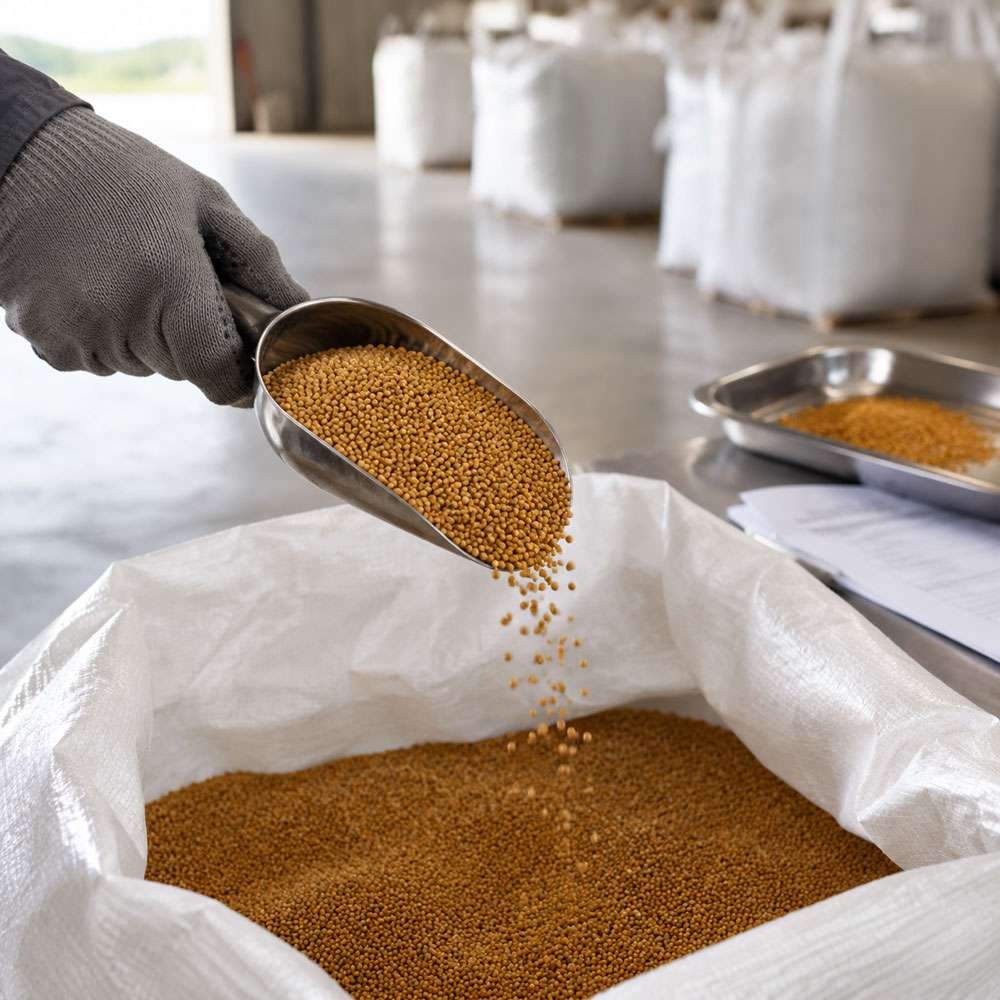
What We Handle
- We select the route and mode of transport: sea, rail, road or a multimodal scheme.
- We supply the container or railcar and organize container stuffing of the lot.
- We advise on the HS code and the set of documents.
- We help organize phytosanitary control and, if the country requires it, disinfestation.
- We prepare the export customs declaration.
- We organize sea freight, rail transport and truck delivery to the buyer.
- We report on every stage of transport.
We collect the lot in the production region. One operator manages the shipment: the total cost is lower, contractors do not have to coordinate with each other, and responsibility for the cargo is not split. We work door to door, without intermediaries.
Where Russian Mustard Goes and What Each Country Requires
According to a preliminary estimate by Agroexport, in 2024 Russia exported about 115 thousand tonnes of mustard seeds, roughly 1.7 times more than in 2023. The largest buyers were Bangladesh (about 26%), Mongolia (about 20%) and Poland (about 18%). Poland took its share mostly before July 2024, when the EU introduced duties, so this figure does not reflect current deals.
| Destination | Transport | Key Documents and Conditions | Status |
|---|---|---|---|
| Bangladesh | Container by sea from Novorossiysk to Chattogram (Chittagong) with transshipment | Phytosanitary certificate; the buyer’s Import Permit | Largest buyer in 2024 |
| Mongolia | Rail, road | Phytosanitary certificate; we confirm the phytosanitary requirements for the shipment date | Second-largest buyer in 2024 |
| Kazakhstan, Uzbekistan and other CIS countries | Rail, road | Phytosanitary certificate; for Uzbekistan and other CIS free trade area countries outside the EAEU, certificate of origin Form CT-1 | Overland routes |
| Turkey | Sea | Phytosanitary certificate; certificate of origin | Possible destination |
| China | Rail, road | Manufacturer registration in CIFER | From September 2026, only powder and prepared mustard; admission of seeds is not confirmed |
| EU | — | Increased EU import duty | The duty makes the shipment noticeably more expensive |
Bangladesh
In 2024, Bangladesh bought more Russian mustard seeds than any other country. A typical scheme is a container to the port of Chattogram (Chittagong) with transshipment at a transit hub.
A phytosanitary certificate is required from the Russian side. The buyer obtains the Import Permit from the Plant Quarantine Wing, and it is advisable to ask the buyer for the permit number and conditions before the lot is inspected. The permit sets the import conditions, including treatment of the lot if it is needed. For this reason, we check whether disinfestation is required against the country’s phytosanitary requirements and the text of the permit.
Mongolia and CIS Countries
Mongolia was the second-largest market in 2024. Shipments go by rail through the Naushki — Sukhbaatar border crossing or by truck. We confirm the phytosanitary requirements for mustard seeds against the country’s requirements on the shipment date.
We ship to Kazakhstan, Uzbekistan and other CIS countries by rail and road. The certificate of origin is easy to get wrong here. Kazakhstan is a member of the EAEU, so a certificate of origin is not needed there to claim import preferences. Uzbekistan and other CIS free trade area countries outside the EAEU require Form CT-1: without it, the buyer does not receive the preferential import regime.
China: What Is Permitted from September 2026
On 17 September 2026, Rosselkhoznadzor (the Russian Federal Veterinary and Phytosanitary Surveillance Service) announced that China had permitted imports of Russian mustard powder and prepared mustard. The manufacturer registers in the CIFER system in the category “Plant-based spices.” It submits the application through a regional office of Rosselkhoznadzor, the agency completes a checklist and a declaration, and then GACC (the General Administration of Customs of China) assigns the company a registration number.We handle customs clearance of the lot.
Mustard seeds were not included in the announcement: as of the publication date, their import into China is not officially confirmed. We check the status before every deal and do not plan seed shipments to China without confirmed admission.
European Union: Why Shipments Fell Sharply
Since 1 July 2024, Council Regulation (EU) 2024/1652 has applied, setting higher duties on Russian cereals and oilseeds, and mustard seeds fall under it. According to the EU customs surveillance system (DG AGRI/TAXUD), from July to November 2024 EU imports of Russian mustard seeds fell by about 90% against the same period a year earlier. In the new season, from 1 July to 4 October 2026, they reached about 1.4 thousand tonnes, 82% less than a year earlier.
An EU buyer should first calculate the import duty and only then plan the shipment: EU duties make deliveries noticeably more expensive. We check the current rate in TARIC on the date of the deal.
How We Ship: Transport, Routes and Packaging
The main scheme is a container from Novorossiysk, our base port. Rail suits Mongolia, Central Asia and powder to China. Trucks suit CIS countries and small lots. A trial lot can go as a consolidated shipment, and you pay only for your own volume. When needed, we select another port of loading or a rail route to the east.
The main risk for oilseeds in transit is moisture. When the temperature changes, condensation forms on the container walls, the seeds absorb moisture and may start to self-heat. For this reason, the lot must be dry before loading. In transit, it is protected by a liner bag, moisture adsorbents and a short stay in port.
Sea, Rail or Road: Which to Choose
We choose the mode of transport by destination country, lot size and Incoterms rule. We confirm the volumes and transit times in the table for each specific route.
| Mode of Transport | Destinations | Lot Size | What to Watch |
|---|---|---|---|
| Sea, container | Bangladesh, Turkey, other countries with sea access | From 18 t in a 20DV | Transshipment, condensation, container free days in port |
| Rail | Mongolia, Kazakhstan, Uzbekistan, China (powder) | From 18 t per railcar or container | Border crossing, SMGS waybill (the international rail consignment note), transloading at the Chinese border because of the different track gauge |
| Road | CIS countries, Mongolia, China (powder) | Up to 20 t per truck | Border crossing time, the document set kept in the cab |
| Consolidated shipment | Trial lots to different destinations | From 1 t | Consolidation period, packing in big bags |
Packaging: Liner Bag, Big Bags or Bulk
The seller and the buyer agree on the packaging. It determines loading speed, protection from moisture and the way the cargo is unloaded at the consignee. Start with how the buyer will receive the cargo: if the buyer has no site for bulk unloading, a container with a liner bag will not work, and big bags are more practical. Mustard seed payload of a 20DV and a 40HQ, in tonnes. Container stuffing site (elevator, port warehouse).
| Option | When It Suits | Protection from Moisture and Contamination | Unloading at the Buyer |
|---|---|---|---|
| 20-foot container with a liner bag | Bulk loading, sea transport | The liner separates the seeds from the container walls and floor; adsorbents limit condensation | A site for bulk unloading is needed |
| Big bags of about 1 t | Trial and consolidated lots, buyer without bulk reception | Each bag is closed; the integrity of the fabric and a dry floor are important | Crane or forklift |
| Bulk in hopper or covered railcars | Rail, large lots | Depends on the cleanliness and condition of the railcar | A bulk cargo reception point is needed |
Documents, HS Code and Quality Requirements
Customs clearance is our core specialization. The table lists the document set for an export lot of mustard seeds and shows who prepares each document.
| Document | Prepared By | When Needed |
|---|---|---|
| Contract, invoice, packing list | Seller | For every lot |
| Export customs declaration | We prepare and file it on the seller’s instruction | For every lot leaving the EAEU |
| Phytosanitary certificate | Rosselkhoznadzor, after inspection and laboratory tests | For each lot, if the importing country requires it; for powder, per the country’s requirements |
| Disinfestation records | A note in the phytosanitary certificate | If the country requires it or pests are found |
| SDIZ in FGIS “Zerno” (“Grain”) | The owner of the lot (the seller); Rosselkhoznadzor confirms the export SDIZ | For mustard seed lots: they are recorded in FGIS “Zerno,” the Federal State Information System for grain, as an oilseed crop. SDIZ is the grain shipment accompanying document |
| Certificate of origin Form CT-1 | Chamber of Commerce and Industry | For CIS free trade area countries outside the EAEU, under the preferential regime |
| General-form certificate of origin | Chamber of Commerce and Industry | At the request of the buyer or the country |
| Quality test reports | Accredited laboratory | As the contract requires |
| Declaration of conformity under TR CU 015/2011 | Applicant (manufacturer or seller) | For circulation in the EAEU and at the buyer’s request |
| Bill of lading, SMGS or CMR | Carrier | Depending on the mode of transport |
| Import Permit | Buyer | Bangladesh |
HS Code and Export Duty
Mustard seeds are declared under code 1207 50: 1207 50 100 0 for sowing and 1207 50 900 0 for other seeds. An error in the subheading, for example a seed code on a commercial lot, raises questions at customs and delays release. For this reason, we check the code against the documents for the lot before the declaration is filed.
As of the publication date, there is no export duty on mustard seeds: code 1207 50 is not on the list of goods subject to export customs duties approved by Government Decree No. 2068. Reference sources still show a 10% rate, but it was set by a 2001 decree that is no longer in force. The list changes several times a year, so we check the current version before filing the declaration.
Phytosanitary Certificate and Disinfestation
Rosselkhoznadzor issues the phytosanitary certificate after inspection and laboratory tests of the lot. The seeds are tested for quarantine pests under the destination country’s requirements, and the electronic application is submitted through the “My Export” portal, the government platform for exporters.
The certificate has a limited validity: the lot must cross the Russian border within 30 calendar days of issue, or within 14 days for exports to EU countries. If the inspection is done early and the shipment slips, the certificate expires and the lot is inspected again. For this reason, we plan the inspection date around the shipment date.
Disinfestation (fumigation) is carried out only if the destination country requires it or pests are found during inspection. A note about it is entered in the certificate. Whether we organize phytosanitary control and disinfestation in-house or through partners.
Lot Quality: What the Buyer Checks
Requirements for mustard seeds are set by GOST 9159-71 and the contract. Under the GOST, the basic moisture content is 12%, and the limit is no more than 16%. Weed impurities: basic 2%, limit no more than 5%. Pest infestation is not permitted, except mite infestation up to degree II.
The buyer may set stricter moisture and impurity limits in the contract, as well as a heavy metals test. For this reason, we check the lot’s parameters against the contract before container stuffing, not after the cargo arrives at the destination port.
How an Export Works: 7 Steps
- Request and quote. You send the product, volume, destination country and packaging, and we prepare the route and rate.
- Code and country requirements check. We check the HS code, phytosanitary requirements and whether the product is admitted. For China, this is a mandatory separate step.
- Incoterms rule and route. We agree the Incoterms rule, mode of transport, and port or station of loading.
- Phytosanitary control. Sampling, inspection, disinfestation if needed, and obtaining the phytosanitary certificate.
- Container stuffing. Loading and sealing the container or railcar.
- Customs. We file the export customs declaration and obtain release.
- Delivery and documents. We deliver the lot and hand the consignee the invoice, packing list, bill of lading or SMGS, phytosanitary certificate and certificate of origin.
At every stage, we tell you where the lot is and what the next step is.
Advantages of Working With Us
- Over 10 years in the international logistics market — an established network of agents and partners worldwide
- One operator instead of a chain of subcontractors — you work with a single company at every stage, instead of coordinating separately with the carrier, customs broker, and freight forwarder
- Single point of responsibility — WestComTrans is accountable for the cargo from warehouse pickup all the way to delivery to the recipient
- Competitive pricing through route optimization — we combine transport types to eliminate unnecessary costs
- Timely updates at every stage — you always know where your cargo is
- Full turnkey support — from cost calculation to closing documents
We transport the following goods:

Chemical raw materials and components

Pharmaceutical products

Electronics and equipment

Textile products

Food products and spices

Construction materials

Clothing and footwear

Industrial equipment

“When a request says just ‘mustard,’ the first thing I ask is whether it is seeds or powder. They are different products. Seeds have their own code and their own set of requirements. Powder has a different code, and it is a food product with different documents and a different list of countries. Until it is clear what exactly is being shipped, it is too early to talk about a route or a rate.” – Alexander Morozov, Logistics Specialist at WestComTrans
If you have any questions about the process of organizing international export shipping of mustard from Russia, or would like to get a consultation, feel free to reach out to us. We’re ready to help you at every stage of your cargo’s delivery!
WestComTrans – International Logistics.
COST OPTIMIZATION

Optimization of clearance and freight costs

Savings on terminal services

Adjustment of customs value

Optimization of final costs
Specify the email address to which we will send the cost calculation
SERVICE

24/7 communication with manager

Deferred payment

We work with and without VAT

Electronic document flow

Correspondence with sender

No hidden fees

Cargo insurance

Full support from purchase to delivery
Specify the email address to which we will send the cost calculation
WE ARE ALREADY TRUSTED


REVIEW


Ответы на частые вопросы
As of the publication date, only mustard powder and prepared mustard are officially permitted. Rosselkhoznadzor announced the admission on 17 September 2026, and shipments are possible after the manufacturer is registered in CIFER. Admission of mustard seeds to China is not confirmed: we check the status before every deal and, until admission is confirmed, we do not plan seed shipments to China.
Code 1207 50. Seeds for sowing have code 1207 50 100 0, and other seeds, for example for processing, have 1207 50 900 0. Mustard powder and prepared mustard belong to a different heading, 2103 30. We check the final code against the documents for the lot before the declaration is filed.
Not on mustard seeds (1207 50): as of the publication date, this code is not on the list of goods subject to export customs duties under Government Decree No. 2068. The 10% rate from older reference sources is no longer in force. The list changes several times a year, so we check the current version before filing the declaration.
Yes. For mustard seeds, it is issued for each lot if the importing country requires the certificate. Bangladesh, for example, will not admit a lot without a phytosanitary certificate and an import permit. Rosselkhoznadzor issues the certificate after inspection and laboratory tests. After issue, the lot must cross the border within 30 days, or within 14 days for exports to EU countries.


