


 China
China India
India Vietnam
 Thailand
 Taiwan
 UAE
UAE Israel
 Indonesia
 Turkey
 Italy
Italy Egypt
Egypt Bangladesh
 Iran
Iran UK
UK Algeria
 Tunisia
 Spain
Spain Malaysia
 Morocco
 Saudi Arabia
 Singapore
 Philippines
 China
China UAE
UAE Japan
Japan South Korea
 Taiwan
 United Kingdom
 Brazil


International Watermelon Shipping to Russia
We deliver shipments by any mode of transport — with temperature control maintained and no loss of marketable condition in transit.
✔ Shipping via Novorossiysk, watermelons and other fruits
✔ APAC standards, any type of temperature regime
✔ Door-to-door delivery with no intermediaries
✔ Multimodal transport: air, road, rail, sea
Specify the email address to which we will send the cost calculation
Watermelon is a seasonal, perishable cargo with a tight delivery window: a ripe melon retains its marketable condition for only 2–3 days without temperature control. Any delay in transit, downtime at the border, or an incorrectly chosen mode of transport results in the loss of the shipment. WestComTrans has organized international shipping of cargo of any complexity for over 10 years and takes on the entire watermelon delivery cycle — from selecting the mode of transport and temperature control through to customs clearance at the border. Working with a single operator instead of a chain of contractors reduces the final shipping cost and rules out situations where no one is responsible for delays or spoilage.
Special Considerations in Transporting Watermelons as Perishable Cargo
Watermelon is a quarantine-regulated perishable product, and this shapes the requirements for the entire logistics chain:
- Short shelf life. A ripe watermelon has 2–3 days before spoiling, so the route and mode of transport are selected to prevent the cargo from getting stuck at intermediate transfers and warehouses.
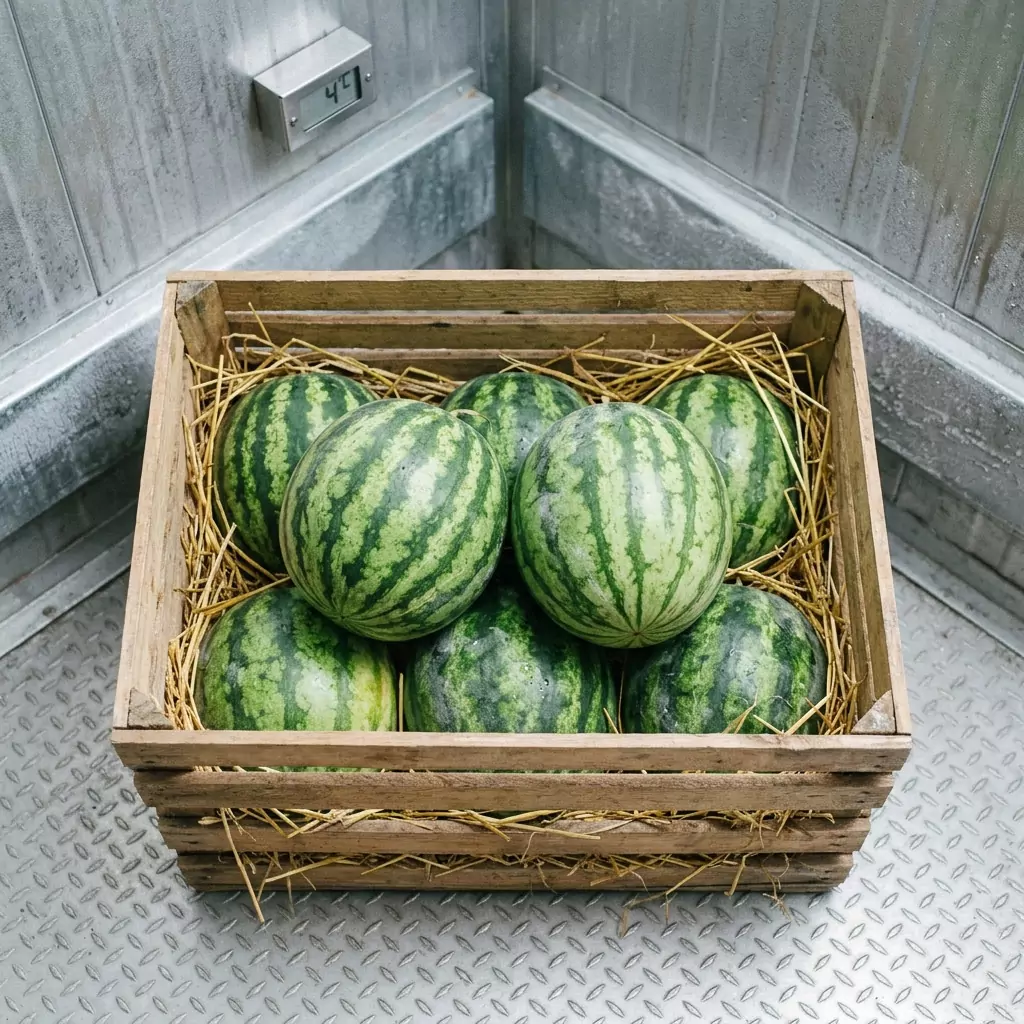
- Temperature regime of +18…+21°C. It’s in this range that a watermelon maintains its flesh structure and doesn’t start overripening.
- Humidity of 80–95%. Insufficient humidity causes the rind to dry out and the shipment to lose weight, while excess humidity encourages mold.
- Ethylene sensitivity. Watermelon releases this gas itself as it ripens, and its buildup in a confined truck bed or container speeds up spoilage of nearby fruit.
These parameters aren’t a recommendation — they’re a condition for preserving the product: breaking even one of them over 2–3 days of transport can turn an entire shipment into scrap.
Modes of Transport for International Watermelon Shipping
The choice of transport depends on shipment volume, route distance, and permissible transit time. WestComTrans works with all modes of transport and selects the optimal scheme for each specific delivery.
| Mode of Transport | Optimal Shipment Volume | Approximate Transit Time | When It’s Used |
|---|---|---|---|
| Road | 1 to 20 tons | 3–7 days | CIS and EAEU countries, distances up to 3,000–4,000 km |
| Rail | from 20 tons | 5–12 days | Large shipments, distant overland routes |
| Sea (refrigerated container) | from 20 tons | 15–35 days | Overseas and distant routes, off-season procurement |
| Air | up to 5–10 tons | 1–3 days | Urgent and premium shipments, short remaining shelf life |
| Multimodal | any | depends on the combination of legs | Cost optimization by combining modes of transport |
Road Shipping
For routes from CIS and EAEU countries — primarily Uzbekistan and Kazakhstan, which today form the bulk of imports — road transport remains the main method for delivering watermelons. For distances that fit within 5–7 days of travel, and with moderate outside temperatures, a refrigerated truck isn’t always necessary: the shipment can be transported in a tarpaulin-covered semi-trailer with adequate cargo bed ventilation, and the trip itself planned mostly for nighttime hours, when air temperature is lower. This scheme reduces shipping costs without compromising cargo quality, but requires precise route and weather planning along the entire journey.
Rail Shipping
Rail is cost-effective for shipping large volumes over long overland distances, where road transport loses out on price. Refrigerated railcars or insulated sections that maintain the set temperature regime throughout the route are used for watermelons. This solution is especially relevant for shipments from regions far from sea ports and border crossings.
Sea and Multimodal Shipping
Sea delivery in refrigerated containers is the main option for distant and overseas routes, where transit time is measured in weeks. The multimodal scheme — a WestComTrans specialty — makes it possible to combine a sea or rail leg with road “last-mile delivery” from the port or arrival station to the recipient’s warehouse. With a single operator handling every stage, downtime at the handoffs between modes of transport — critical for perishable cargo — is eliminated.
Air Shipping
Air transport is used less often — only for small shipments, when the remaining shelf life doesn’t allow for land or sea transport, or for premium varieties with a high value per ton. In transit, the product is delivered within 1–3 days, while temporary storage warehouses at airports maintain a temperature of around +2…+5°C — the standard storage condition for most imported fruit, though for watermelon it’s important to minimize the time spent at the bonded warehouse (SVKh) itself.
Temperature Regime and Storage Conditions During Transport
| Parameter | Standard |
|---|---|
| Transport temperature | +18…+21°C |
| Humidity | 80–95% |
| Short-term storage temperature at the bonded warehouse (air, SVKh) | +2…+5°C |
| Shelf life of ripe fruit | 2–3 days |
In addition to temperature and humidity, cargo preservation directly depends on the packaging and how it’s arranged in the truck bed or container:
- the fruit is arranged in rows with padding material that prevents contact and friction between the watermelons;
- the vehicle is treated before loading and must be clean and dry;
- rotten, cracked, or overripe fruit is not permitted in the truck bed or container — a single damaged watermelon accelerates spoilage of the entire shipment;
- the packaging protects the cargo from direct sunlight and sharp temperature swings during loading and unloading operations.
Ethylene Control and Cargo Quality in Transit
Watermelon, like most fruit and vegetable produce, releases ethylene — a gas that speeds up ripening. In the confined space of a truck bed or container, ethylene concentration builds up faster than in open air, triggering a chain reaction: the higher the gas concentration, the faster nearby fruit in the shipment overripens and spoils. That’s why ventilation of the space matters just as much as temperature during transport — either forced ventilation in a refrigeration unit, or natural ventilation when using tarpaulin-covered transport during cooler hours of the day. WestComTrans takes this factor into account when selecting the vehicle and planning the route, so the shipment retains its marketable condition by the time it arrives.
Main Routes and Countries Supplying Watermelons
According to data from Rusprodsoyuz and Rosselkhoznadzor, in 2026 the bulk of imported watermelons entering Russia comes from three countries:
- Uzbekistan — the clear leader in supply, with annual import volume having nearly doubled; delivered mainly by road, under a duty-free regime within the CIS;
- Kazakhstan — an EAEU country, road shipments without the full customs procedure cycle when the product is sold within the Union;
- Iran — delivered by road and multimodal transport via southern border crossings.
Shipments from Turkey and Azerbaijan are also growing noticeably — driven by increasing volumes and an expanding range of sourcing countries. WestComTrans is based in Novorossiysk — one of the key ports for receiving container cargo from Mediterranean and Black Sea Basin countries, which shortens the delivery leg for the Turkish route and multimodal schemes involving a sea leg.
When working with any of these countries, it’s worth noting that Rosselkhoznadzor regularly introduces targeted phytosanitary restrictions on individual exporters when violations are detected — this underscores the importance of checking the supplier and accompanying documents even at the shipment preparation stage. During transport planning, WestComTrans checks the supplier’s status and the completeness of phytosanitary documentation, to rule out cargo delays at the border.
Customs Clearance of Watermelons in International Shipping
Importing watermelons into Russia requires customs clearance under HS code 0807 11 000 0. Releasing a shipment requires a phytosanitary certificate from the exporting country, a declaration of conformity, and correctly completed labeling. For EAEU countries, the full cycle of customs procedures isn’t required, provided the product is sold within the Union. WestComTrans handles all the permits and takes on watermelon customs clearance in parallel with organizing transport — read more about this on the “Customs Clearance of Cargo” page.
Advantages of Working With Us
Our company has specialized in international transportation of perishable goods for over 10 years. We provide a complete range of services – from pickup at the supplier to delivery to the recipient’s warehouse, while maintaining all cold chain requirements.
Our Advantages:
- Over 10 years of experience in international food transportation;
- Our own fleet of vehicles and network of reliable partners worldwide;
- Competitive rates through route and capacity optimization;
- Dedicated logistics specialist for each transaction;
- Strict adherence to delivery timelines with no hidden costs.
We transport the following goods:

Fruits

Vegetables

Berries

Greens

Meat and meat products

Fish and seafood

Mushrooms

Plants and flowers

“Watermelon is cargo that doesn’t forgive delay: two to three days, and the shipment loses its marketable condition. We calculate the entire route in advance — from the temperature regime in the truck bed to the supplier’s status and phytosanitary documents — so the client gets not just transport, but a guarantee that the cargo will arrive fresh with no surprises at the border.” – Alexander Morozov, Logistics Specialist at WestComTrans
If you have any questions about the process of organizing international watermelon shipping, or would like to get a consultation, feel free to reach out to us. We’re ready to help you at every stage of your cargo’s delivery!
WestComTrans – International Logistics.
COST OPTIMIZATION

Optimization of clearance and freight costs

Savings on terminal services

Adjustment of customs value

Optimization of final costs
Specify the email address to which we will send the cost calculation
SERVICE

24/7 communication with manager

Deferred payment

We work with and without VAT

Electronic document flow

Correspondence with sender

No hidden fees

Cargo insurance

Full support from purchase to delivery
Specify the email address to which we will send the cost calculation
WE ARE ALREADY TRUSTED


REVIEW


Ответы на частые вопросы
By road — from 3 to 7 days, depending on the point of dispatch and border crossing congestion.
Yes, for shipments from EAEU countries over short distances, transport in a tarpaulin-covered vehicle with cargo bed ventilation and the trip scheduled for cooler hours of the day is acceptable.
For shipments up to 20 tons over distances up to 3,000–4,000 km, road transport is optimal.
The cargo moves via several modes of transport within a single route — for example, by sea to the port of Novorossiysk and then by road to the recipient’s warehouse — with no need to re-issue the contract at each leg.


