


 China
China India
India Vietnam
 Thailand
 Taiwan
 UAE
UAE Israel
 Indonesia
 Turkey
 Italy
Italy Egypt
Egypt Bangladesh
 Iran
Iran UK
UK Algeria
 Tunisia
 Spain
Spain Malaysia
 Morocco
 Saudi Arabia
 Singapore
 Philippines
 China
China UAE
UAE Japan
Japan South Korea
 Taiwan
 United Kingdom
 Brazil


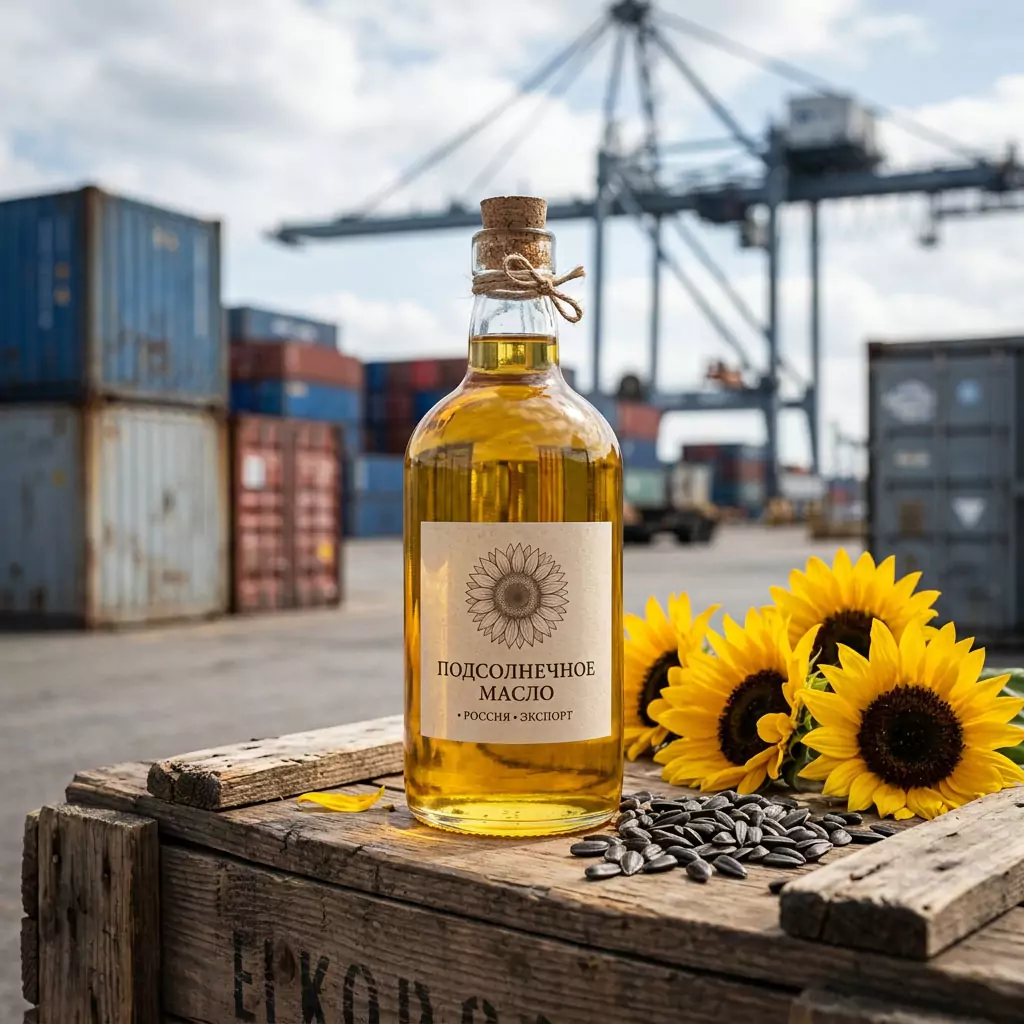
Sunflower Oil Export from Russia
We organize turnkey shipments to Saudi Arabia, the UAE, Egypt, India, China, and European countries — from route calculation to delivery of the cargo to the buyer. One operator, no intermediaries.
✔ Sea, rail, road, air, and multimodal solutions
✔ Customs clearance and permit documentation — turnkey
✔ 10+ years in international logistics
✔ Cost calculation within one business day
Specify the email address to which we will send the cost calculation
Russia is the world’s largest exporter of sunflower oil, and its shipping destinations are genuinely broad: the oil is purchased by India, China, Turkey, Egypt, Gulf countries (Saudi Arabia, the UAE), as well as European markets — Spain, Italy, and others. In essence, Russian-made sunflower oil is in demand in virtually every country in the world. For over 10 years, WestComTrans has organized turnkey international shipping and customs clearance: we handle route calculation, document preparation, customs clearance, and door-to-door delivery to the recipient, working with the client as a single operator with no intermediaries.
The Sunflower Oil Export Market: Scale and Geography
By the end of the 2024/2025 season, Russia ranked first in the world in sunflower oil exports with a share of around 36% of the global market, and in the 2025/2026 season, according to estimates from the federal center “Agroexport,” this share could exceed 40%. The main buyers are India, Turkey, Iran, Belarus, and China, with substantial volumes also going to Egypt, Saudi Arabia, and the UAE, while Spain and Italy generate steady demand from Europe. In the first half of 2026, exports of Russian fats and oils products grew by 22% year-on-year in monetary terms. This broad geographic reach reflects the product’s consistent quality and pricing: Russian sunflower oil is competitive in virtually any market, whether in Asia, the Middle East, or Europe.
Shipping Destinations: Key Ports and Routes
Sunflower oil from Russia is shipped to virtually every region in the world — from India and China to the Middle East and Europe. Below are the main destinations WestComTrans works with most often, along with practical port details.
Saudi Arabia and the UAE: Ports and the Current Route Situation
The UAE is not just an end market — it’s also a major transit hub: the port of Jebel Ali receives container lines from virtually all major shipping operators. Saudi Arabia imports oil through the ports of Jeddah (Red Sea) and Dammam (Persian Gulf) — the choice of port depends on which part of the country the buyer is located in.
Important update. On June 11, 2026, Iran announced the closure of the Strait of Hormuz to all types of vessels, and direct sea traffic through the strait — the route used for cargo to Jebel Ali and Dammam — has been disrupted. Part of the cargo flow is now being redirected overland through Saudi Arabia to the port of Jeddah on the Red Sea, from where vessels continue via the Suez Canal and the Bosphorus — this increases delivery time (up to 35 days instead of the usual 15–20) and shipping costs, which have risen 2.5–3 times on certain routes since the start of 2026. The situation is changing rapidly, so we confirm the route and cost for Jebel Ali and Dammam individually based on the shipment date — meanwhile, shipments via Jeddah and via the Egyptian port (accessible directly through the Suez Canal, bypassing the strait) are currently more logistically stable.
Egypt and Other Countries in the Region
Egypt is one of the historically largest importers of Russian sunflower oil, with well-established logistics chains through the port of Alexandria. Beyond the main destinations, WestComTrans organizes shipments to virtually any country — Jordan, Lebanon, Israel, and other markets in the region — we select the route and delivery scheme individually for the specific volume and destination port at the calculation stage.
Sunflower Oil Shipping Methods
The type of transport is chosen based on shipment volume, timelines, and destination port.
| Transport | Delivery Time | When It’s Appropriate |
|---|---|---|
| Sea (container) | 15–20 days (Egypt, Jordan, Jeddah); up to 35 days (Jebel Ali, Dammam — due to rerouting via Jeddah) |
The primary method for volumes of 1 container or more — for the Middle East, Asia, and Europe |
| Multimodal (sea + road) | 20–40 days | Recipients without direct sea access or located far from the unloading port |
| Road | 7–15 days | Small shipments, countries with a land border |
| Rail | 10–20 days | Combined schemes, an alternative to sea when ports are congested |
| Air | 2–5 days | Only for samples or urgent small shipments — not used for the main oil volume |
Sea container shipping is optimal for most destinations, with a multimodal scheme applied when the recipient is located far from the port.

Bulk or Packaged: How Sunflower Oil Is Transported
Sunflower oil for export is shipped in two ways: in bulk via flexitanks — for large shipments intended for further processing — and in packaging — glass or plastic bottles, canisters — for retail deliveries. Let’s take a closer look at how bulk shipping works, since this method is most commonly used for exporting large volumes.
How Flexitank Shipping Works
A flexitank is a single-use, flexible polymer liner installed inside a standard 20-foot container, turning it into a vessel for bulk liquid cargo.
- Container preparation. The technical condition of the 20-foot container is checked at the shipper’s warehouse — no punctures, no foreign odors, and a flat floor with no protruding fittings that could damage the liner.
- Flexitank installation. The liner is unfolded inside the container, the neck and valve are secured at the container doors, and protective bracing (a bulkhead) is installed at the entrance to prevent the flexitank from being pushed out during filling and transport.
- Filling with oil. A hose from the shipper’s pumping equipment is connected to the flexitank’s valve. The standard liner capacity is up to 24,000 liters, with 21–21.5 tons of net oil actually loaded (the exact volume depends on the product’s density and the flexitank model).
- Inspection and sealing. After filling, the connections are checked for leaks, the valve is closed and sealed, and the container doors are sealed.
- Transportation. The loaded container is transported to the departure terminal in the same manner as any other cargo — no special temperature regime or separate storage facility is required for flexitanks.
In terms of documentation and quarantine (phytosanitary) control, bulk shipping is not fundamentally different from packaged shipping — the same set of certificates, the same cargo inspection procedure at the border. The only difference lies in the packaging method and the equipment requirements at the shipper’s warehouse: bulk shipping requires a pump and a prepared area for installing the liner.
Packaged Shipping
Packaged oil — in glass bottles, plastic bottles, or canisters — is shipped in a 40-foot container: transporting packaged cargo in a 20-foot container is not cost-effective due to low weight utilization. The maximum load capacity of a 40-foot container is about 28 tons, but accounting for axle load restrictions during road transport, no more than 24 tons is permitted for loading.
The choice between bulk and packaged shipping should be agreed upon with your account manager at the calculation stage, since it affects both the container type and the final shipping cost.
Stages of Sunflower Oil Export with WestComTrans
- Consultation and calculation. We confirm the volume, port of departure and destination, packaging method (bulk/packaged), and calculate the shipping cost.
- Contract signing. We finalize the terms, route, and timelines.
- Classification and document preparation. We assign the HS code and prepare the contract, invoice, certificates of origin, and phytosanitary certificate.
- Customs clearance. We file the declaration, support the cargo inspection process, and monitor release into free circulation.
- Transportation. We arrange shipping via the selected transport type — sea, multimodal, road, or rail.
- Door delivery. We hand over the cargo to the recipient at the destination port or deliver it to the final address.
A single manager oversees all stages — this eliminates the gap in accountability between different contractors that typically occurs when working with multiple logistics companies at once.
Documents and Customs Clearance
The standard document package for sunflower oil exports:
- Foreign trade contract
- Invoice
- Customs declaration
- Certificate of origin
- Phytosanitary certificate
- EAEU HS code (for sunflower oil — group 1512, the exact code depends on the degree of refinement and packaging, e.g., 1512199002 for refined oil in primary packaging up to 10 L)
WestComTrans handles the preparation of the entire document package, including guidance on the specific requirements of the destination country and buyer.
Cost and Factors Affecting Shipping Rates
The final price is made up of several variables: container type and size (20 or 40 feet), port of departure and destination, packaging method (bulk is more expensive than packaged due to the flexitank), Incoterms conditions under the contract, seasonal congestion on shipping lines, and the export duty on sunflower oil — calculated monthly under the “damper” mechanism (70% of the difference between the base and indicative price) and subject to noticeable month-to-month changes. Below are approximate sea freight rates from the port of Novorossiysk for preliminary budget estimation; please confirm the exact rate for your shipment date with your account manager.
Important: the situation on the route through the Strait of Hormuz. Since June 2026, direct sea traffic to Persian Gulf ports has been disrupted due to the closure of the Strait of Hormuz, and part of the container flow is now being rerouted — overland through Saudi Arabia to Jeddah, then by sea via the Suez Canal. According to available logistics market data, shipping costs on this route rose 2.5–3 times between February and June 2026, and delivery time increased to up to 35 days. Because of this, the rates for Jebel Ali and Dammam below are provided as a “pre-crisis” reference point only — the actual cost at the time of your request may be significantly higher and can change even on a weekly basis, so for these two destinations we always recalculate the rate individually based on the shipment date.
Sea Freight Rates from the Port of Novorossiysk
| Destination Port | 40′ HQ, $ | 20′ DV, $ |
|---|---|---|
| Saudi Arabia, Jeddah (stable route via the Red Sea) |
5850 (packaged) | 5850 (flexitank) |
| Saudi Arabia, Dammam (currently — only via transshipment in Jeddah) |
from 2200, confirmed individually |
from 2200, confirmed individually |
| UAE, Jebel Ali (currently — only via transshipment in Jeddah) |
from 3500, confirmed individually |
from 3500, confirmed individually |
| Egypt, Alexandria (route via the Suez Canal, bypassing the Strait of Hormuz) |
1920 | 1700 |
| Egypt, El Dekheila | 1920 | 1700 |
| Jordan, Aqaba (route via the Red Sea, bypassing the Strait of Hormuz) |
upon request | upon request |
| Israel, Ashdod | 2130 | 1700 |
| Lebanon, Beirut | 4450 | 3150 |
| Turkey, Ambarli (Istanbul) | 800 | 700 |
| Turkey, Mersin | 1800 | 1700 |
| China, Nansha / Ningbo / Shanghai | 1120 | 1120 |
| India, Mundra / Nhava Sheva | 1870 | 1550 |
*Prices are indicative and do not include fuel surcharges, war risk fees, or transshipment costs. A flexitank can only be installed in a 20-foot container (20′ DV), so the “40′ HQ” column reflects the rate for packaged cargo. For Jebel Ali and Dammam, the actual rate on your inquiry date may differ several-fold from the figures shown — request a precise calculation from your account manager.
Advantages of Working With Us
- Over 10 years in the international logistics market — an established network of agents and partners worldwide
- One operator instead of a chain of subcontractors — you work with a single company at every stage, instead of coordinating separately with the carrier, customs broker, and freight forwarder
- Single point of responsibility — WestComTrans is accountable for the cargo from warehouse pickup all the way to delivery to the recipient
- Competitive pricing through route optimization — we combine transport types to eliminate unnecessary costs
- Timely updates at every stage — you always know where your cargo is
- Full turnkey support — from cost calculation to closing documents
We transport the following goods:

Chemical raw materials and components

Pharmaceutical products

Electronics and equipment

Textile products

Food products and spices

Construction materials

Clothing and footwear

Industrial equipment

“We’ve been working with sunflower oil exports to the Middle East and Europe for years now, and we know the difference between ‘just shipping a container’ and managing a deal from calculation all the way through to the client receiving payment. Each country — Saudi Arabia, the UAE, Egypt, India, China, Spain, Italy — requires its own approach. Our job is to take the logistics and customs headache off the client’s plate entirely, so they can focus on sales instead of untangling the finer points of HS codes.” – Alexander Morozov, Logistics Specialist at WestComTrans
If you have any questions about organizing international export shipping of sunflower oil from Russia, or would like a consultation, feel free to reach out to us. We’re ready to help you at every stage of your cargo’s journey!
WestComTrans – International Logistics.
COST OPTIMIZATION

Optimization of clearance and freight costs

Savings on terminal services

Adjustment of customs value

Optimization of final costs
Specify the email address to which we will send the cost calculation
SERVICE

24/7 communication with manager

Deferred payment

We work with and without VAT

Electronic document flow

Correspondence with sender

No hidden fees

Cargo insurance

Full support from purchase to delivery
Specify the email address to which we will send the cost calculation
WE ARE ALREADY TRUSTED


REVIEW


Ответы на частые вопросы
The liner is unfolded inside a standard 20-foot container, the valve is secured at the doors, and protective bracing is installed, after which the oil is pumped in through a hose. The standard capacity is up to 24,000 liters, with 21–21.5 tons of net oil actually loaded.
Before the closure of the Strait of Hormuz in June 2026, direct sea container shipping was the answer. Currently, cargo to Jebel Ali and Dammam is routed via transshipment in Jeddah, so the optimal scheme and timeline need to be confirmed based on the shipment date. A multimodal scheme (sea + road) remains relevant for Jordan and recipients located far from the port.
The minimum package includes a contract, invoice, customs declaration, certificate of origin, and phytosanitary certificate. For Saudi Arabia and the UAE, a Halal certificate is additionally mandatory.
To Jeddah — approximately 15–20 days. To Jebel Ali and Dammam, currently — up to 35 days, due to cargo being rerouted through Jeddah because of the situation in the Strait of Hormuz; once the situation normalizes, timelines will return to 20–25 days.
Both options are possible. Bulk shipping in a flexitank is used for large, regular shipments if the shipper has the necessary filling equipment; packaged oil in bottles or canisters is loaded into a 40-foot container.


