


 China
China India
India Vietnam
 Thailand
 Taiwan
 UAE
UAE Israel
 Indonesia
 Turkey
 Italy
Italy Egypt
Egypt Bangladesh
 Iran
Iran UK
UK Algeria
 Tunisia
 China
China UAE
UAE Japan
Japan South Korea
 Taiwan
 United Kingdom
 Brazil


Customs Clearance and Cargo Declaration – Fast, Compliant, Turnkey
Every day without a released declaration means warehouse storage costs at a temporary storage facility, late fees, and the risk of customs value adjustments. We handle the entire process: from classifying goods under the EAEU Commodity Nomenclature (TN VED) to obtaining the released customs declaration and delivering cargo to your warehouse. Freight and customs clearance — in a single contract, with no gap in responsibility between contractors.
✔ Clearance from 1 business day
✔ Over 10 years in the market
✔ Import and export
✔ All types of transport
✔ Operating across Russia and the EAEU
Specify the email address to which we will send the cost calculation.
What Is Customs Clearance of Cargo
Customs clearance is a mandatory procedure for any goods crossing the state border of Russia or another EAEU member country. Without it, the cargo will not be released for free circulation, and any violation of the declaration procedure results in an administrative fine under Article 16.2 of the Code of Administrative Offences of the Russian Federation — for legal entities, from one-half to twice the amount of unpaid customs duties, with possible confiscation of the goods.
In common usage, the procedure goes by different names: rastamozha (customs import clearance) — when bringing goods into Russia, zatamozha (customs export clearance) — when exporting, and customs clearance — in international logistics. The legal framework is the EAEU Customs Code (CC EAEU), in force since January 1, 2018. Goods may be declared by the declarant themselves (the importer or exporter) or by an authorized customs representative — a company listed in the Federal Customs Service of Russia registry.

Types of Customs Clearance
WestComTrans works with all major customs procedures:
→ Import (IM40 — release for domestic consumption) — bringing goods into Russia with full payment of duties and VAT. The most common procedure.
→ Export (EK10) — exporting Russian goods abroad. Requires filing a customs declaration, compliance with export controls, and where necessary — obtaining licenses.
→ Customs Transit (CT) — movement of foreign goods under customs supervision from the border to an inland customs post without payment of duties. Requires a guarantee and strict adherence to deadlines.
→ Temporary Import / Export — for exhibition equipment, containers, and machinery sent for repair. Duties are either partially paid or waived entirely.
→ Re-import and Re-export — return of previously exported or imported goods. Applied in cases of goods rejection, defects, or logistical errors.
→ Processing on the Customs Territory — importing raw materials for manufacturing with subsequent export of the finished product.
Stages of Customs Clearance
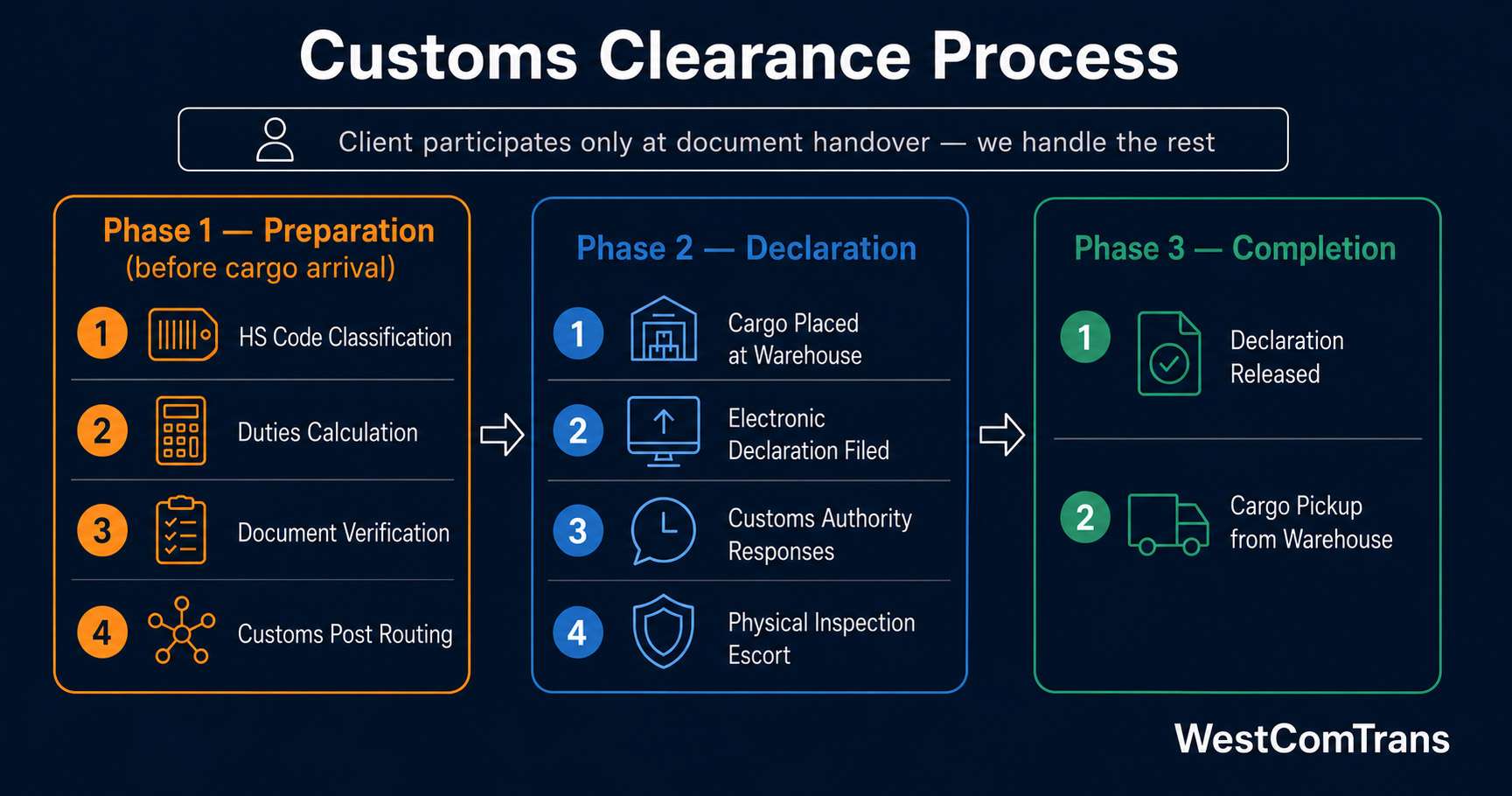
The entire process from document receipt to declaration release takes place in three phases. The client is only involved at the document handover stage — we handle everything else.
Phase 1 — Preparation (before cargo arrival)
- Commodity classification under the EAEU TN VED — we assign a 10-digit code to each item. The duty rate, VAT, and requirements for certificates and permits all depend on this code.
- Calculation of customs payments — duty, VAT (22% standard rate from 2026, 10% reduced rate for certain goods), excise duty where applicable, and the customs clearance fee.
- Document package verification — we cross-check the invoice, packing list, contract, and transport documents. Any discrepancies are resolved before the cargo arrives, not after.
- Determination of the customs post — since 2021, the Federal Customs Service’s automated dispatching system independently assigns declarations to Electronic Customs Declaration Centers (ECDC). Direct influence over post selection is not possible; however, an accurate product description and correct TN VED code determine whether the cargo is routed to a specialized post (food, medical, automotive) — which directly affects release speed.
Phase 2 — Declaration
- Placement of cargo at a temporary storage facility (TSF) — arrival at the customs control zone, identification of cargo units.
- Submission of the electronic customs declaration (CD) to the ECDC — no need to visit a customs post in person; everything is handled remotely via a digital signature (EDS).
- Responding to customs inquiries — if an inspector requests additional documents or clarifications, our customs clearance specialist responds within one hour.
- Inspection support — if the Risk Management System (RMS) triggers an inspection, we are present during the examination and document the condition of the cargo.
Phase 3 — Completion
- Release of the customs declaration (CD) — we receive the release confirmation and provide the client with a copy of the declaration.
- Removal of cargo from the TSF — we arrange handover to the carrier or delivery to the client’s warehouse.
Documents for Customs Clearance
The document package depends on the type of goods and the procedure. The standard set for import looks as follows:
Commercial
- Foreign trade contract
- Commercial invoice
- Proforma invoice (if available)
- Packing list
- Unique Contract Number (UCN) for transactions exceeding 3 million RUB
- Payment documents confirming payment for the goods
Transport
- CMR (Road transport) / Bill of Lading (Sea freight) / AWB (Air freight) / RWB (Rail freight)
- Carrier agreement
- Transit declaration (for customs transit)
- Insurance policy (if available)
- Freight invoice
Permits & Certificates
- EAC conformity certificate / declaration
- Certificate of origin (ST-1, Form A)
- Phytosanitary or veterinary certificate
- Chestny Znak labeling codes (for goods subject to mandatory labeling)
- Ministry of Industry and Trade license (where required)
For a preliminary cost estimate, an invoice, packing list, and product description are sufficient. All other documents are requested as needed.
Cost of Customs Clearance
It is important to distinguish between two cost components. Customs payments — duty, VAT (from January 1, 2026, the standard rate is 22%, reduced rate of 10% for certain categories), excise duty, and the customs clearance fee — are calculated based on the TN VED code and the customs value of the goods; these are mandatory government payments. Broker service fees — WestComTrans’s charge for declaration filing and process management.
| Service | Timeframe | Cost |
|---|---|---|
| Consultation on document requirements (incl. phytosanitary certificate) | 1 day | Free of charge |
| Preparation and verification of customs clearance documents | 2–3 days | From 18,000 RUB/container |
| Assistance in obtaining a permit certificate | 5–7 days | From 5,000 RUB/container |
| Turnkey customs clearance (declaration filing + duty payment) | 1 business day | On request |
*Prices are VAT-exclusive. The final cost depends on the mode of transport, the number of commodity lines in the declaration, the availability of permit documents, and the customs value of the shipment. Exact calculation available on request within 2 hours.
Customs Clearance Timeframes
Under Article 119 of the EAEU Customs Code, customs authorities are required to release a declaration within 4 hours of its registration. In practice, with a complete document package, the declaration is released on the same or the next business day.
Timeframes increase in four cases:
- RMS trigger — customs assigns an inspection or additional value verification
- Document discrepancies — mismatched data between the invoice and the packing list
- Missing permit document — conformity certificate, license, or veterinary certificate
- Customs transit deadline violation — if the cargo is moving through transit from a port and the carrier missed the deadline
All four causes of delay are eliminated at the preparation stage. We verify documents in advance — before the cargo arrives, not after.
Why Handling Customs Clearance Yourself Costs More
Companies that attempt customs clearance on their own for the first time, or hire an inexperienced broker, most commonly encounter four typical mistakes. Each one translates into real financial losses.
Incorrect TN VED Code
Customs assesses additional duty based on the correct code plus a fine for inaccurate declaration. The difference in rates between adjacent codes can reach 10–15% of the goods’ value.
Missing Certificate at the Time of Declaration Filing
The cargo is not released and sits at the TSF. Container storage costs in the customs control zone range from 3,000 to 10,000 RUB/day and higher depending on the terminal and storage duration (rates increase progressively: the longer the storage, the higher the cost). A week of downtime adds up to 21,000–70,000+ RUB in storage costs alone — and that excludes container demurrage charges.
Price Discrepancy Against the Risk Profile
Customs initiates a customs value adjustment (CVA) — assessing additional payments based on the “market” price from its own database. Challenging a CVA without a solid evidence base is virtually impossible.
Customs Transit (CT) Deadline Violation
If the carrier failed to deliver the container to the inland customs post on time — an administrative fine for legal entities under Article 16.10 of the Code of Administrative Offences of the Russian Federation of up to 10,000 RUB — but the main risk is different: forfeiture of the customs payment security deposit (which can amount to hundreds of thousands of rubles) and detention of the entire shipment pending investigation.
WestComTrans: freight and customs — one operator
Most companies hire a freight forwarder and a customs broker separately. At the interface between them, information gets lost, responsibility becomes diffuse, and delays arise. WestComTrans covers the entire cargo journey — from the supplier’s factory to your warehouse.
Single Contract
One agreement covering both freight and customs. No disputes over “who is responsible for the delay” between two separate contractors.
Documents Prepared in Transit
While the cargo is on its way, we are already preparing the customs declaration. By the time the vessel or truck arrives — the declaration is ready for submission.
All Modes of Transport
Sea, air, rail, road, multimodal. We select the optimal route based on transit time and cost.
Single Point of Responsibility
We bear joint liability before the Federal Customs Service of Russia for the accuracy of declaration filing — as required by law.
Key Changes in Customs Clearance in 2026
Over the past few months, two major changes have taken place that directly affect the cost and procedure of customs clearance.
Import VAT — Rate Increased to 22%
From January 1, 2026, the standard VAT rate in Russia increased from 20% to 22%. This also applies to import VAT at customs clearance: the rate in effect on the date of customs declaration registration is applied. The reduced rate of 10% for certain product categories (some food products, children’s goods, medicines) has been retained.
Practical implication: the customs value of the same shipment, all else being equal, now carries a 2% higher tax burden. This needs to be factored into the supply budget at the contract stage.
SPOT — Advance VAT Payment for Imports from EAEU Countries from June 1, 2026
For importers bringing goods from EAEU member states (Belarus, Kazakhstan, Armenia, Kyrgyzstan) by road, the SPOT system has been introduced from June 1, 2026 (Federal Law No. 101-FZ dated 17.04.2026). Prior to crossing the border, it is now required to:
- Submit an advance delivery notification through the Federal Tax Service portal
- Make a security payment covering VAT and excise duties before the goods enter the country
- Obtain a QR code which the carrier presents at the border
Without a QR code, goods will not be allowed to cross the border. Authorized Economic Operators (AEO) and systemically important companies are granted a deferral until June 2027 (Presidential Decree No. 263 dated 20.04.2026). If you import goods from EAEU member states — contact us in advance to clarify the procedures under the new scheme.
If you have any questions about the shipping container transportation process or would like to get advice, do not hesitate to contact us. We are ready to help you at every stage of your cargo delivery!
WestComTrans is an international logistics company.
COST OPTIMIZATION

Optimization of clearance and freight costs

Savings on terminal services

Adjustment of customs value

Optimization of final costs
Specify the email address to which we will send the cost calculation
SERVICE

24/7 communication with manager

Deferred payment

We work with and without VAT

Electronic document flow

Correspondence with sender

No hidden fees

Cargo insurance

Full support from purchase to delivery
Specify the email address to which we will send the cost calculation
WE ARE ALREADY TRUSTED


REVIEW


Ответы на частые вопросы
The costs consist of two parts. Customs payments (duty + VAT at 22% from 2026, reduced rate of 10% for certain categories + clearance fee) — these are mandatory government payments, the amount of which is determined by the TN VED code and the customs value of the goods. WestComTrans broker service fees — from 10,000 RUB for document preparation per container. An exact calculation of both components is provided within 2 hours based on the invoice and product description.
With a complete document package — 1 business day. The statutory timeframe under Article 119 of the EAEU Customs Code is 4 hours from the moment of declaration registration. Delays occur when there are document discrepancies, a Risk Management System (RMS) trigger, or missing permit documents. We address all of these risks in advance.
The EAEU TN VED is a 10-digit commodity code used in foreign trade activities. It determines the customs duty rate, the applicability of VAT and excise duty, the list of mandatory certificates, and import restrictions. An error of 1–2 digits in the code can shift the duty rate from 0% to 15% and add a certification requirement that will hold the cargo at the TSF.
Yes, if your company has a certified declarant, a digital signature (EDS), and licensed software for electronic declaration filing. In practice, this is cost-effective for high volumes of regular shipments of the same type of goods. For one-off shipments and new product categories, engaging a customs representative is less expensive than maintaining an in-house specialist.
A CVA is an additional assessment of customs payments when the declared price of the goods is below the statistical average for the given TN VED code in the Federal Customs Service database. Customs recalculates the duty and VAT (22% from 2026) based on its own reference price. To avoid a CVA, a solid evidence package is required: bank payment documents, manufacturer’s price list, and the export declaration from the country of origin. We prepare this package proactively for sensitive product categories.


