


 China
China India
India Vietnam
 Thailand
 Taiwan
 UAE
UAE Israel
 Indonesia
 Turkey
 Italy
Italy Egypt
Egypt Bangladesh
 Iran
Iran UK
UK Algeria
 Tunisia
 Spain
Spain Malaysia
 Morocco
 Saudi Arabia
 Singapore
 Philippines
 China
China UAE
UAE Japan
Japan South Korea
 Taiwan
 United Kingdom
 Brazil


Fertilizer Export from Russia
We organize the transportation of mineral and organic fertilizers by sea, rail, road, and multimodal schemes — from the plant to the destination port. We handle customs clearance, documentation, and hazardous cargo, so you work with a single operator at every stage.
✔ Sea, rail, road, air, and multimodal solutions
✔ Customs clearance and permit documentation — turnkey
✔ 10+ years in international logistics
✔ Cost calculation within one business day
Specify the email address to which we will send the cost calculation
Russia remains one of the world’s largest fertilizer suppliers, and as shipment volumes grow, so do the logistics requirements: the cargo is moisture-sensitive, part of the nomenclature is classified as hazardous, and a precise document package is needed at the border. WestComTrans organizes turnkey exports of mineral and organic fertilizers — from plant pickup to unloading at the destination port — with customs clearance and a single accountable operator at every stage, with no chain of subcontractors.
What Fertilizers We Export
We work with the full range of fertilizers, taking into account the cargo’s physical and chemical properties, as well as packaging and storage requirements.
Mineral Fertilizers
- Nitrogen-based — urea, ammonium sulfate, ammonium nitrate;
- Potassium-based — potassium chloride;
- Phosphate-based;
- Complex — NPK, azofoska, diammofoska.
Mineral fertilizers are moisture-sensitive, shipped in bulk, big bags, or sacks, and are subject to mandatory conformity assessment under EAEU Technical Regulation 039/2016.
Organic Fertilizers
Peat, compost, manure, sapropel, humus. These do not require mandatory certification — a voluntary quality certificate is sufficient, along with a veterinary or phytosanitary control opinion if needed.
Fertilizer Export Shipping Methods
We combine transport types depending on shipment volume, destination, and timeline — this is the foundation of multimodal logistics.
| Method | Shipment Volume | Timeline | When It’s Cost-Effective |
|---|---|---|---|
| Sea, bulk | from 3,000 t | 20–55 days | large shipments, lowest cost per ton |
| Sea, in big bags / containers | from 1 to 1,000 t | 15–35 days | medium shipments, countries with underdeveloped port infrastructure |
| Rail | from 60 t (railcar) | 5–15 days to port | transporting raw material from the plant to the shipping port |
| Road | up to 24–28 t | 3–10 days | urgent and small shipments, regional destinations |
| Multimodal scheme | any volume | depends on the combination | cost and time optimization through switching transport types |
Sea Freight
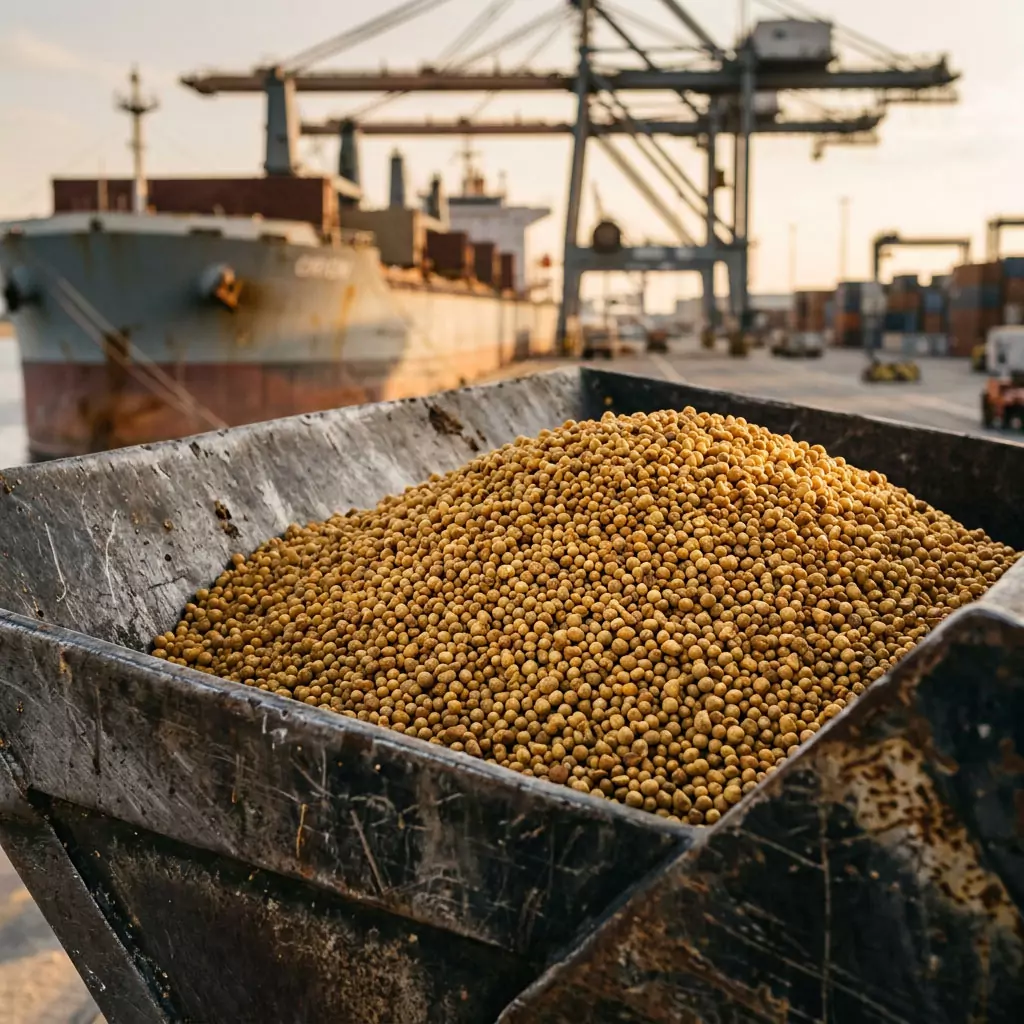
Bulk — cargo is loaded directly into bulker holds, the most cost-effective option for shipments of 3,000 tons or more. Big bags (break bulk) — packaged product on general cargo ships, suitable for ports with underdeveloped unloading infrastructure. Containers — for shipments up to 500–1,000 tons, offering a more flexible liner service to a wide range of ports.
Rail Freight
Bulk fertilizers are shipped in hopper cars — self-unloading railcars with sealed hatches that prevent moisture ingress and cargo spillage. Liquid fertilizers (aqueous ammonia, UAN) are shipped in tank cars and tank containers made of stainless steel or aluminum alloys resistant to the cargo’s corrosive properties.
Road Freight
We use road transport for urgent and small shipments. Vehicles carrying hazardous fertilizers require a special permit, and the driver must hold the corresponding certification; cargo packaging and labeling are handled according to the standards established for the specific type of fertilizer.
Multimodal Schemes
Example: a plant deep in Russia → road or rail delivery to the port of Novorossiysk → ocean freight to the destination port. Combining transport types reduces empty mileage and lowers the overall shipping cost compared to working through several separate contractors.
Export Geography: Ports and Destinations
The main shipping hub is Novorossiysk: its container and general cargo facilities send fertilizers to Turkey, the Middle East, Africa, and Asia. For large shipments of potassium and nitrogen fertilizers, we occasionally also use the Baltic ports (Ust-Luga, St. Petersburg), where specialized fertilizer transshipment facilities are concentrated.
| Destination | Port of Departure | Transport | Estimated Time |
|---|---|---|---|
| Brazil and Latin America | Novorossiysk, Ust-Luga | sea, large-tonnage vessels | 35–50 days |
| India | Novorossiysk / Baltic | sea (via the Suez Canal or around Africa) |
25–35 days via the Suez Canal, 45–55 days around the Cape of Good Hope |
| China | Far East, overland border crossings |
sea / rail | 20–40 days |
| Turkey | Novorossiysk | sea | 5–10 days |
| African countries | Novorossiysk | sea | 20–35 days |
| Middle East | Novorossiysk | sea / multimodal | 10–20 days |
Timelines are approximate and depend on freight seasonality and line congestion. One particular nuance concerns the Red Sea: since late 2023, major shipping lines have largely routed around Africa, and only starting in July 2026 have certain services begun partially returning to the Suez Canal route. We confirm the current route and timeline for the India/Middle East destination at the time of booking.
Documents and Customs Clearance for Fertilizer Exports
The cargo goes through the standard procedure: filing the goods declaration → verifying the HS code → currency control → checking for outstanding customs debts → inspection and cargo release.
The basic document package: foreign trade contract, invoice, specification, packing list, transport documents, certificate of origin, declaration of conformity (for mineral fertilizers).
Mineral fertilizers are subject to mandatory conformity assessment under EAEU Technical Regulation 039/2016 — instead of the former GOST R declaration, a state registration certificate is required, which remains valid indefinitely across Russia and the EAEU. For organic fertilizers, certification is voluntary. Since January 1, 2025, Russia has abolished the flexible (“exchange rate–linked”) export duty on fertilizers — exporters currently do not pay an export duty, and customs payments on this side fall to the importer. Preparation of the declaration, HS code classification, and currency transaction control, however, remain the exporter’s responsibility.
We also account for duties on the importer’s side: in the EU, an increased specific surcharge applies to the base 6.5% rate on Russian nitrogen and complex fertilizers, rising through 2028, while the US applies countervailing duties on phosphate fertilizers. For this reason, we primarily focus on routes to Asia, Africa, the Middle East, and Latin America, where such barriers don’t apply.
Advantages of Working With Us
- Over 10 years in the international logistics market — an established network of agents and partners worldwide
- One operator instead of a chain of subcontractors — you work with a single company at every stage, instead of coordinating separately with the carrier, customs broker, and freight forwarder
- Single point of responsibility — WestComTrans is accountable for the cargo from warehouse pickup all the way to delivery to the recipient
- Competitive pricing through route optimization — we combine transport types to eliminate unnecessary costs
- Timely updates at every stage — you always know where your cargo is
- Full turnkey support — from cost calculation to closing documents
We transport the following goods:

Chemical raw materials and components

Pharmaceutical products

Electronics and equipment

Textile products

Food products and spices

Construction materials

Clothing and footwear

Industrial equipment

“Fertilizer export is a field where simply finding a vessel isn’t enough. You have to keep track of the remaining Ministry of Industry and Trade quota, the cargo’s hazard class, IMDG Code requirements, and timelines that are currently fluctuating due to the situation in the Red Sea. We take all of this on ourselves — from route calculation to the final customs document — so the client gets a ready-made solution, not a list of problems they have to solve on their own.” – Alexander Morozov, Logistics Specialist at WestComTrans
If you have any questions about organizing international export shipping of fertilizers from Russia, or would like a consultation, feel free to reach out to us. We’re ready to help you at every stage of your cargo’s journey!
WestComTrans – International Logistics.
COST OPTIMIZATION

Optimization of clearance and freight costs

Savings on terminal services

Adjustment of customs value

Optimization of final costs
Specify the email address to which we will send the cost calculation
SERVICE

24/7 communication with manager

Deferred payment

We work with and without VAT

Electronic document flow

Correspondence with sender

No hidden fees

Cargo insurance

Full support from purchase to delivery
Specify the email address to which we will send the cost calculation
WE ARE ALREADY TRUSTED


REVIEW


Ответы на частые вопросы
Organic fertilizers and most of the remaining product range can be exported without special permits. However, since December 2021, non-tariff quotas have applied to nitrogen and complex mineral fertilizers, and the government has extended them almost without interruption (the current period runs through November 30, 2026), so exports to third countries generally require a Ministry of Industry and Trade license within the quota. We confirm the remaining quota and any specific restrictions (such as the temporary suspension of ammonium nitrate exports in spring 2026) before each shipment.
In bulk, cargo is loaded directly into the ship’s hold — this is the cheapest option for shipments of 3,000 tons or more. In big bags, fertilizer is packed into flexible containers and loaded onto general cargo vessels — this format is needed when the unloading port isn’t equipped for bulk unloading.
Novorossiysk is the main shipping port for Turkey, the Middle East, Africa, and Asia; for Brazil and Latin America, we use both Novorossiysk and Ust-Luga. To India, some vessels currently route via the Suez Canal, while others go around Africa due to the situation in the Red Sea, so we select the route and timeline for this destination based on the specific shipment date. Deliveries to China are also possible via Far East ports.
On average 35–50 days, depending on the destination port and line congestion — the exact timeline is confirmed at the vessel booking stage.


