


 China
China India
India Vietnam
 Thailand
 Taiwan
 UAE
UAE Israel
 Indonesia
 Turkey
 Italy
Italy Egypt
Egypt Bangladesh
 Iran
Iran UK
UK Algeria
 Tunisia
 Spain
Spain Malaysia
 Morocco
 Saudi Arabia
 China
China UAE
UAE Japan
Japan South Korea
 Taiwan
 United Kingdom
 Brazil


Shipping containers from Malaysia to Russia
✔ Delivery time from 20 days
✔ Cost from $3000
✔ We work with all ports in Malaysia
Specify the email address to which we will send the cost calculation
WestComTrans organizes turnkey international sea freight from Malaysia to Russia — from cargo collection at the supplier’s premises to delivery to the recipient’s warehouse. We operate as a single operator: we coordinate sea freight, customs clearance, and delivery across Russia ourselves, so you do not lose time on coordination between different contractors and do not overpay for intermediary links.
Shipments are available from the ports of Port Klang, Tanjung Pelepas, Penang, and Johor Bahru with delivery to Novorossiysk, Saint Petersburg, or Vladivostok. We work with legal entities, support import and foreign trade transactions, and handle all documentation.
Transit Times and Routes for Sea Freight from Malaysia
There are three main delivery schemes, and both the transit time and cost depend on the choice of route.
Direct sea delivery to the European part of Russia, via the Cape of Good Hope. Due to the unstable situation in the Red Sea, most container lines since the end of 2023 and to this day have been routing cargo to Europe and Russia not via the Suez Canal but around the Cape of Good Hope. This adds approximately 10–14 days to the voyage and increases the fuel cost component, so actual delivery times to Novorossiysk and Saint Petersburg are currently higher than they were before 2024. Some carriers in early 2026 cautiously attempted to return to the Suez route, but due to the escalating situation in the Middle East, many have again suspended such sailings — therefore when planning transit times, we use the Cape of Good Hope route as the primary scenario.
Multimodal delivery via the Far East. Cargo travels by sea to the port of Vladivostok or Vostochny (15–20 days), then by rail to Moscow (approximately 15 days) taking into account train formation waiting time (approximately 7 days). Total transit time — 20–35 days. This route is not dependent on the situation in the Red Sea and remains the most predictable option for cargo where speed is a priority.
Route via the Suez Canal. Used selectively by certain carriers with security caveats — the situation in the region can change rapidly, so we only offer this option where a specific carrier confirms such a sailing, and do not include it as a guaranteed default option.
We select the route based on the specific cargo and the client’s priority — minimum cost or minimum transit time — and verify the current situation with the carriers at the time of calculation, as the Red Sea situation continues to evolve.
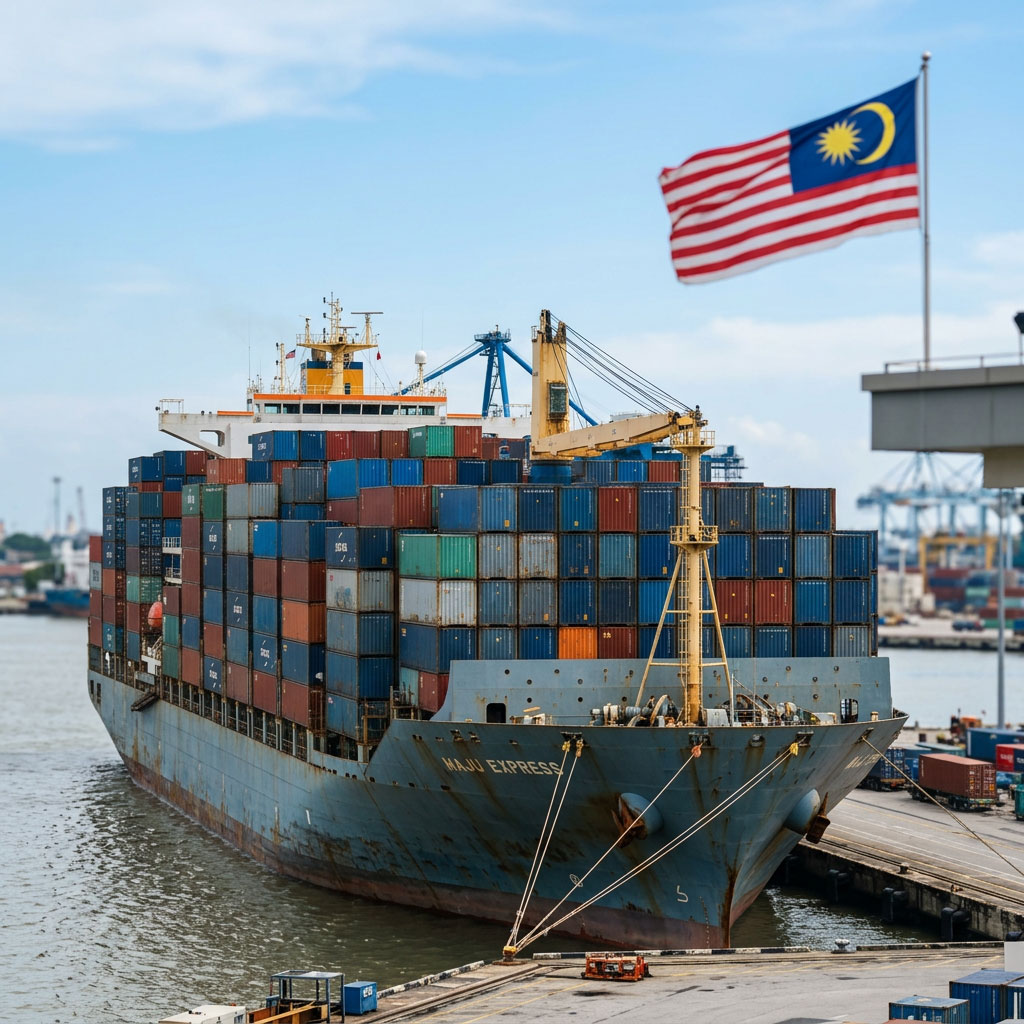
Ports of Departure in Malaysia and Ports of Delivery in Russia
| Port of departure (Malaysia) | Port of destination (Russia) | Indicative transit time* | Indicative cost, 20 DC / 40 HC |
|---|---|---|---|
| Port Klang | Novorossiysk | 50–65 days | from $4,700 / from $6,500 |
| Port Klang | Saint Petersburg | 55–70 days | from $5,200 / from $7,200 |
| Tanjung Pelepas | Vladivostok / Vostochny | 20–35 days (sea + rail) | from $3,000 / from $4,500 |
| Penang | Novorossiysk | 50–65 days | from $5,300 / from $7,600 |
| Johor Bahru | Saint Petersburg | 55–70 days | from $5,800 / from $8,300 |
* Transit times are indicated taking into account that the majority of container lines as of mid-2026 are still routing via Africa around the Cape of Good Hope rather than through the Suez Canal.
Multimodal Delivery Schemes from Malaysia
Combining modes of transport is a key advantage of working with a single operator. We combine sea freight with a rail or road leg within Russia, which reduces the total cost and shortens transit time compared to using several different contractors at different stages. For example, delivery via the Far East by sea and then by rail to Moscow is faster than a direct sea route to European ports, while working through a single operator eliminates coordination gaps between the sea carrier, customs broker, and road transport company.
Customs Clearance for Cargo from Malaysia
For customs clearance, a standard document package will be required: commercial invoice, packing list, bill of lading, certificate of origin, and for certain categories — conformity certificates and permit documents.
Independent customs clearance is suitable for companies with foreign trade experience who are prepared to navigate the nuances of customs legislation. If such experience is lacking, we handle customs clearance in full: we determine TN VED codes, calculate duties, prepare the declaration, and accompany the cargo at all stages of inspection. More details on the cargo customs clearance page.
Why Work With Us
We take pride in the fact that our clients return to us time and again, entrusting us with the organization of container shipping from Malaysia:
- Tailored approach — we develop logistics solutions that account for the specific needs of your business;
- Years of experience — over 10 years of successful international freight operations;
- Transparent pricing — no hidden fees or unexpected costs;
- Responsive communication — a dedicated personal manager available 24/7;
- Full-cycle services in one place — sea freight, customs clearance, certification, delivery across Russia, and bonded warehousing — all through a single operator. No need to coordinate multiple contractors.
We transport the following goods:

Chemical raw materials and components

Pharmaceutical products

Electronics and equipment

Textile products

Food products and spices

Construction materials

Clothing and footwear

Industrial equipment

“When working with the Malaysia route, our primary goal is to take the headache of deadlines and documentation off the client’s shoulders. The situation on sea routes is currently quite unstable — due to the situation in the Red Sea, many vessels are routing around Africa, and transit times have objectively increased. We do not hide this from the client; instead, we immediately factor realistic timeframes into the calculation and offer an alternative via the Far East when speed is a priority. Our job is to ensure the cargo arrives on time and without surprises at customs — not to leave the client to figure out for themselves why the container has been delayed.” – Alexander Morozov, Logistics Manager at WestComTrans
If you have questions about the process of organizing container shipping from Malaysia or would like to receive a consultation, don’t hesitate to contact us. We are ready to help you at every stage of delivering your cargo!
WestComTrans is an international logistics company.
COST OPTIMIZATION

Optimization of clearance and freight costs

Savings on terminal services

Adjustment of customs value

Optimization of final costs
Specify the email address to which we will send the cost calculation
SERVICE

24/7 communication with manager

Deferred payment

We work with and without VAT

Electronic document flow

Correspondence with sender

No hidden fees

Cargo insurance

Full support from purchase to delivery
Specify the email address to which we will send the cost calculation
WE ARE ALREADY TRUSTED


REVIEW


Ответы на частые вопросы
Port Klang is the most commonly used — it is closer to Kuala Lumpur and suitable for most cargo types. Tanjung Pelepas is convenient for routes via the Far East, and Penang is preferable for cargo from the northern part of the country.
The price depends on the container type, port, season, and the scope of additional services. We provide an exact calculation individually upon request — the price may vary depending on current shipping line rates.
Yes, we arrange groupage cargo delivery, which allows small shipments to be ordered without the need to purchase an entire container.
The basic package is a commercial invoice, packing list, bill of lading, and certificate of origin. Certain product categories require additional conformity certificates.


