


 China
China India
India Vietnam
 Thailand
 Taiwan
 UAE
UAE Israel
 Indonesia
 Turkey
 Italy
Italy Egypt
Egypt Bangladesh
 Iran
Iran UK
UK Algeria
 Tunisia
 Spain
Spain Malaysia
 Morocco
 Saudi Arabia
 Singapore
 Philippines
 China
China UAE
UAE Japan
Japan South Korea
 Taiwan
 United Kingdom
 Brazil


International Apricot Shipping to Russia
We deliver fresh, dried, and processed apricots from Uzbekistan, Turkey, Azerbaijan, Iran, and other countries — with full temperature control maintained throughout the entire route and turnkey clearance.
✔ Shipping via Novorossiysk, apricots and other fruits
✔ APAC standards, any type of temperature regime
✔ Door-to-door delivery with no intermediaries
✔ Multimodal transport: air, road, rail, sea
Specify the email address to which we will send the cost calculation
Apricot is one of the most logistically demanding fruits. A fresh apricot keeps without loss of quality for only 2–4 days, is sensitive to temperature fluctuations and mechanical damage, and loses its marketable condition even before reaching the recipient’s warehouse if transport conditions are broken. WestComTrans organizes international apricot shipping — fresh, dried (dried apricots), and processed — by sea, road, rail, air, and multimodal transport from Uzbekistan, Turkey, Azerbaijan, Iran, and other supplying countries. We take on the entire route door-to-door: transport selection, temperature control, customs clearance, and phytosanitary control — with no intermediaries and a single responsible party at every stage.
Special Considerations in International Apricot Shipping
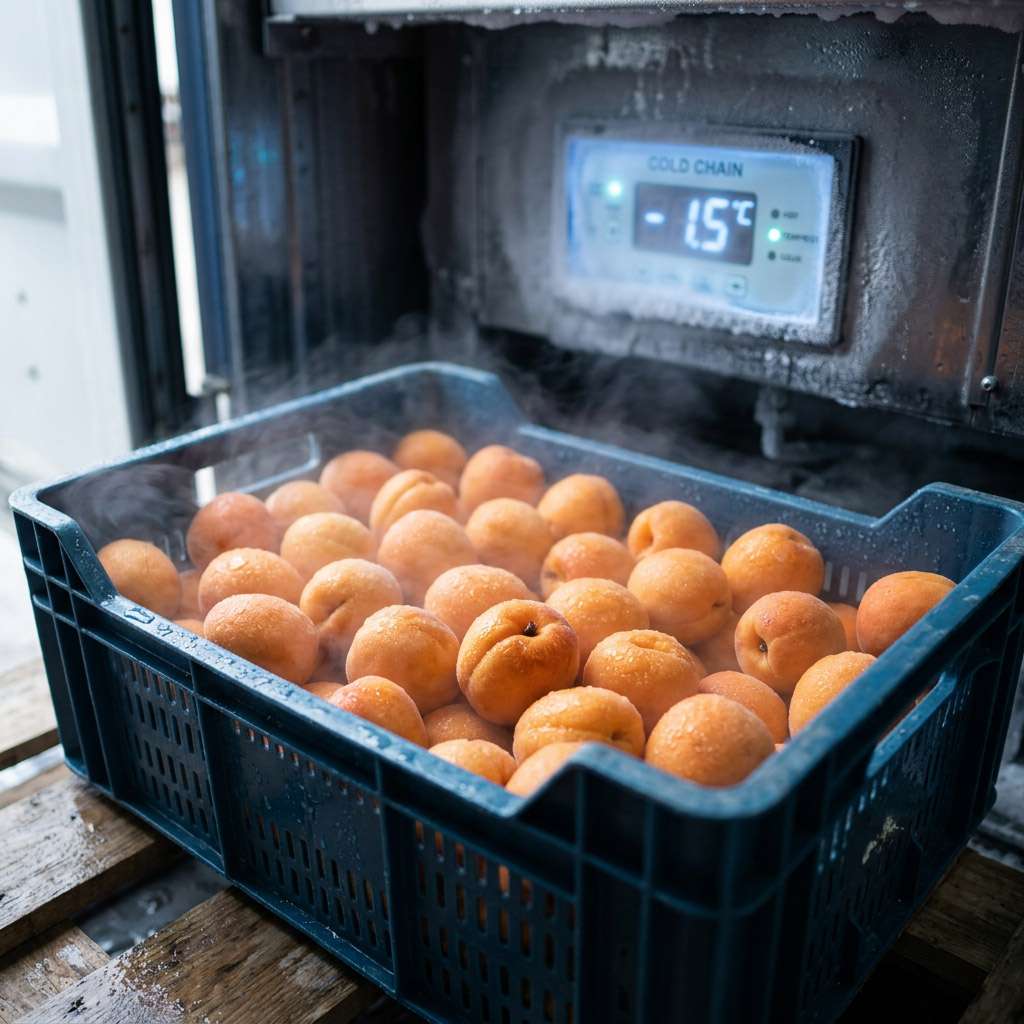
Apricot spoils faster than most fruits due to its high moisture content and thin skin. Immediately after harvest, the fruit needs to be cooled to +3…+5°C — this slows metabolism and keeps the flesh from losing firmness. Breaking the temperature regime for even a few hours noticeably increases the share of defective product in a shipment, whereas maintaining the cold chain throughout the route keeps losses to a minimum.
Key parameters we monitor during transport:
- Temperature — 0 to +5°C for fresh fruit
- Humidity — 90–95%; at lower humidity, apricots dry out, and at higher humidity, there’s a risk of mold
- Shelf life — 2–4 days for fresh fruit with no special treatment
- Packaging — ventilated trays with individual cells that prevent the fruit from touching each other
Dried apricots and canned products are less demanding in terms of temperature, but are also subject to humidity control and protection of the packaging from damage.
Modes of Transport for Shipping Apricots
The choice of transport depends on the type of product, shipment volume, and permissible transit time.
- Air shipping — optimal for fresh apricots from countries with a longer transport leg, or when delivery time is critical.
- Refrigerated road transport — the primary method for delivery from neighboring countries (Uzbekistan, Azerbaijan, Iran), with direct temperature control throughout the route.
- Refrigerated rail container — a cost-effective option for canned products, dried apricots, and large shipments where transit time is less critical.
- Refrigerated sea container — used for delivering processed products (jam, canned goods) and dried apricots over long distances.
- Multimodal shipping — a combination of several modes of transport within a single delivery. This makes it possible to combine the cost-effectiveness of a sea or rail leg with a fast road “last mile,” and reduces the final delivery cost by eliminating intermediaries at route handoffs.
Comparing Delivery Times
| Mode of Transport | Delivery Time | When It’s Used |
|---|---|---|
| Air | 2–3 days | Fresh fruit, urgent shipments |
| Road (refrigerated) | 1–4 days | Neighboring countries (CIS, Iran) |
| Refrigerated rail container | 5–12 days | Dried apricots, canned goods, large volumes |
| Refrigerated sea container | 20–35 days | Processed products, distant destinations |
The timelines given are approximate and depend on the specific route, port congestion, and seasonal factors — we calculate exact timelines individually for each route.
Storage and Transport Conditions for Apricots
Maintaining the shipment’s marketable condition throughout the route depends not just on temperature but also on stability — sharp fluctuations harm the fruit more than a consistently low temperature.
| Parameter | Value |
|---|---|
| Temperature (fresh fruit) | 0…+5°C |
| Humidity | 90–95% |
| Pre-cooling | 4–6 hours immediately after harvest |
| Transport type | Refrigerated truck, refrigerated container, air with temperature control |
| Packaging | Ventilated trays, with no direct contact between fruit |
Before loading a shipment, we recommend pre-cooling at the sender’s warehouse — this reduces the risk of spoilage even before transport begins, and is especially important for delivery by sea or rail, where the journey takes several weeks.
Countries Supplying Apricots
| Country | Supply Notes |
|---|---|
| Uzbekistan | One of the largest suppliers to Russia, an early and abundant harvest |
| Turkey | A major exporter; targeted phytosanitary restrictions apply to certain exporters — the route is confirmed individually before dispatch |
| Azerbaijan | Fresh fruit shipments, ripening 1–2 weeks earlier than southern regions of Russia |
| Iran | Large volumes, dark sweet varieties, requiring strict temperature control |
| Morocco | Winter-period shipments, modified atmosphere packaging |
We monitor current phytosanitary restrictions for each supplying country and select the route accordingly — this rules out the risk of import refusal after the shipment has already been dispatched.
Customs Clearance and Phytosanitary Control
Apricots are declared under HS code 0809 10 000 0 (fresh fruit). The base import duty rate is 5%. A reduced VAT rate of 10% applies to fresh fruit; for processed products (jam, canned goods), the standard VAT rate applies.
Cargo from EAEU countries (Kazakhstan, Kyrgyzstan, Belarus) and with a CT-1 certificate of origin may be imported on preferential terms. A mandatory requirement for any shipment is a phytosanitary certificate: without it, the cargo will not be released from customs regardless of the other documents.
Important: phytosanitary restrictions on individual supplying countries are introduced quickly and can change during the season. Before dispatching a shipment, we check the current status of the country of origin with Rosselkhoznadzor, to rule out the risk of delay or an import ban while the cargo is already in transit.
Documents for Shipping and Customs Clearance of Apricots
- Contract and invoice
- Packing list
- Phytosanitary certificate from the country of dispatch
- Certificate of origin (CT-1 / Form A — for preferential rates)
- Declaration of conformity with TR TS for food products
- Transport waybill (CMR / air waybill / bill of lading — depending on the mode of transport)
Common Mistakes in Apricot Shipping and How to Avoid Them
- Dispatching without checking current phytosanitary restrictions for the country of origin → import ban at the border and loss of the shipment. Solution — check the supplying country’s status before booking transport; Rosselkhoznadzor restrictions can be introduced during the season without warning.
- Breaking the cold chain during loading → loss of marketable condition even before crossing the border. Solution — pre-cooling and checking the vehicle’s temperature before loading.
- Missing phytosanitary certificate or errors in its preparation → cargo delay at the border and a fine. Solution — check the documents before dispatching the shipment.
- Incorrectly selected HS code → duty recalculation, delayed release. Solution — code selection by specialists before the declaration is submitted.
- Delay at the bonded warehouse (SVKh) longer than a day → additional storage costs and risk of spoilage for perishable cargo. Solution — a pre-agreed document package that speeds up clearance.
Advantages of Working With Us
Our company has specialized in international transportation of perishable goods for over 10 years. We provide a complete range of services – from pickup at the supplier to delivery to the recipient’s warehouse, while maintaining all cold chain requirements.
Our Advantages:
- Over 10 years of experience in international food transportation;
- Our own fleet of vehicles and network of reliable partners worldwide;
- Competitive rates through route and capacity optimization;
- Dedicated logistics specialist for each transaction;
- Strict adherence to delivery timelines with no hidden costs.
We transport the following goods:

Fruits

Vegetables

Berries

Greens

Meat and meat products

Fish and seafood

Mushrooms

Plants and flowers

“Apricot is one of the most temperamental cargo types we work with. There’s no room for error here: if the temperature regime is broken even at the loading stage, the shipment loses its marketable condition before it’s even underway. That’s why we agree on transport conditions with the supplier in advance — from pre-cooling to selecting the right reefer container — and keep the cargo under control at every stage, right up to handover to the recipient.” – Alexander Morozov, Logistics Specialist at WestComTrans
If you have any questions about the process of organizing international apricot shipping, or would like to get a consultation, feel free to reach out to us. We’re ready to help you at every stage of your cargo’s delivery!
WestComTrans – International Logistics.
COST OPTIMIZATION

Optimization of clearance and freight costs

Savings on terminal services

Adjustment of customs value

Optimization of final costs
Specify the email address to which we will send the cost calculation
SERVICE

24/7 communication with manager

Deferred payment

We work with and without VAT

Electronic document flow

Correspondence with sender

No hidden fees

Cargo insurance

Full support from purchase to delivery
Specify the email address to which we will send the cost calculation
WE ARE ALREADY TRUSTED


REVIEW


Ответы на частые вопросы
For fresh fruit, air shipping (for urgent deliveries) or refrigerated road transport for neighboring countries are optimal — both options make it possible to stay within the 2–4 day shelf life.
At a temperature of 0…+5°C and humidity of 90–95% — up to 2–4 days for fresh fruit. Dried apricots and canned goods keep considerably longer and don’t require temperature control.
Contract, invoice, packing list, phytosanitary certificate, and, for shipments from EAEU countries, a CT-1 certificate of origin to obtain the preferential duty rate.
Yes, consolidation with other perishable products is possible provided the temperature regimes are compatible — this is coordinated at the route-planning stage.
Contact the customs broker to quickly clarify the reason for the delay — most often this is due to a missing document or a temporary phytosanitary restriction on the country of origin. With WestComTrans’s full-service support, such situations are identified in advance.


