


 China
China India
India Vietnam
 Thailand
 Taiwan
 UAE
UAE Israel
 Indonesia
 Turkey
 Italy
Italy Egypt
Egypt Bangladesh
 Iran
Iran UK
UK Algeria
 Tunisia
 Spain
Spain Malaysia
 Morocco
 Saudi Arabia
 Singapore
 Philippines
 China
China UAE
UAE Japan
Japan South Korea
 Taiwan
 United Kingdom
 Brazil


Container Delivery from the Philippines to Russia
✔ Delivery time from 30 days
✔ Cost from $4300
✔ We work with all ports in Philippines
Specify the email address to which we will send the cost calculation
International sea shipping from the Philippines is the primary method for delivering electronics, coconut oil, ore raw materials, rattan furniture, and textiles to Russia. WestComTrans operates on this route from the ports of Manila, Cebu, and Davao: we accept full container load (FCL) shipments and consolidated (LCL) cargo from 0.1 m³, process the cargo under our own customs representative seal, and deliver it to the recipient’s warehouse in any region of Russia.
Important to understand from the start: there are no direct sea services between the Philippines and Russian ports. Every container travels with transshipment at an Asian hub — Singapore, Busan, Qingdao, or Ningbo. The timeline, as well as the risk of the container being “rolled” to the next sailing, depends on which hub and which line are chosen. We work under direct contracts with shipping lines and take on the entire transit ourselves: the client gets a single contract, a single point of contact, and one responsible party for the whole route.
Ports of Origin in the Philippines and Shipping Routes to Russia
The Philippines is made up of more than seven thousand islands, and the choice of loading port is determined less by tariff than by where the supplier is physically located.
- Manila (Luzon) — the country’s main container hub, from which the bulk of exports depart: electronics, components, consumer goods.
- Cebu (Visayas) — the second-largest port by volume, handling furniture, rattan and shell products, textiles, and footwear.
- Davao (Mindanao) — agricultural products, coconut oil, fruit, ore raw materials.
- Clark and General Santos — used for specific cargo categories and air shipments.
From there, the cargo travels with transshipment at a hub and arrives at one of three Russian ports.
| Route | Scheme | Duration |
|---|---|---|
| Manila / Cebu → Vladivostok | sea + transshipment | 28–35 days |
| Manila / Cebu → Moscow | sea + rail (SEA+RAIL) | 30–40 days |
| Manila → Novorossiysk | sea + transshipment | 40–50 days |
| Manila → St. Petersburg | sea + transshipment | 45–55 days |
Vladivostok and Vostochny are the fastest option, with onward shipment by rail to Moscow, St. Petersburg, Yekaterinburg, and Novosibirsk. Novorossiysk is advantageous for recipients in Southern and Central Russia: WestComTrans has its own infrastructure and staff of customs declarants there, so the cargo isn’t handed off to third-party contractors or left waiting for a broker.
Consolidating Cargo Between Islands
A typical situation on this route: three suppliers, three islands, three different warehouses, and not a single container. Organizing the shipment from the Philippines is more complicated than the sea voyage itself.
We pick up the goods from each supplier, deliver them to a consolidation warehouse in Manila or Cebu, check completeness and packaging, repack and palletize if needed, and then ship everything as a single consignment under one bill of lading. The client receives one set of documents and one departure date instead of three uncoordinated shipments.
Cost and Timelines for Sea Shipping from the Philippines
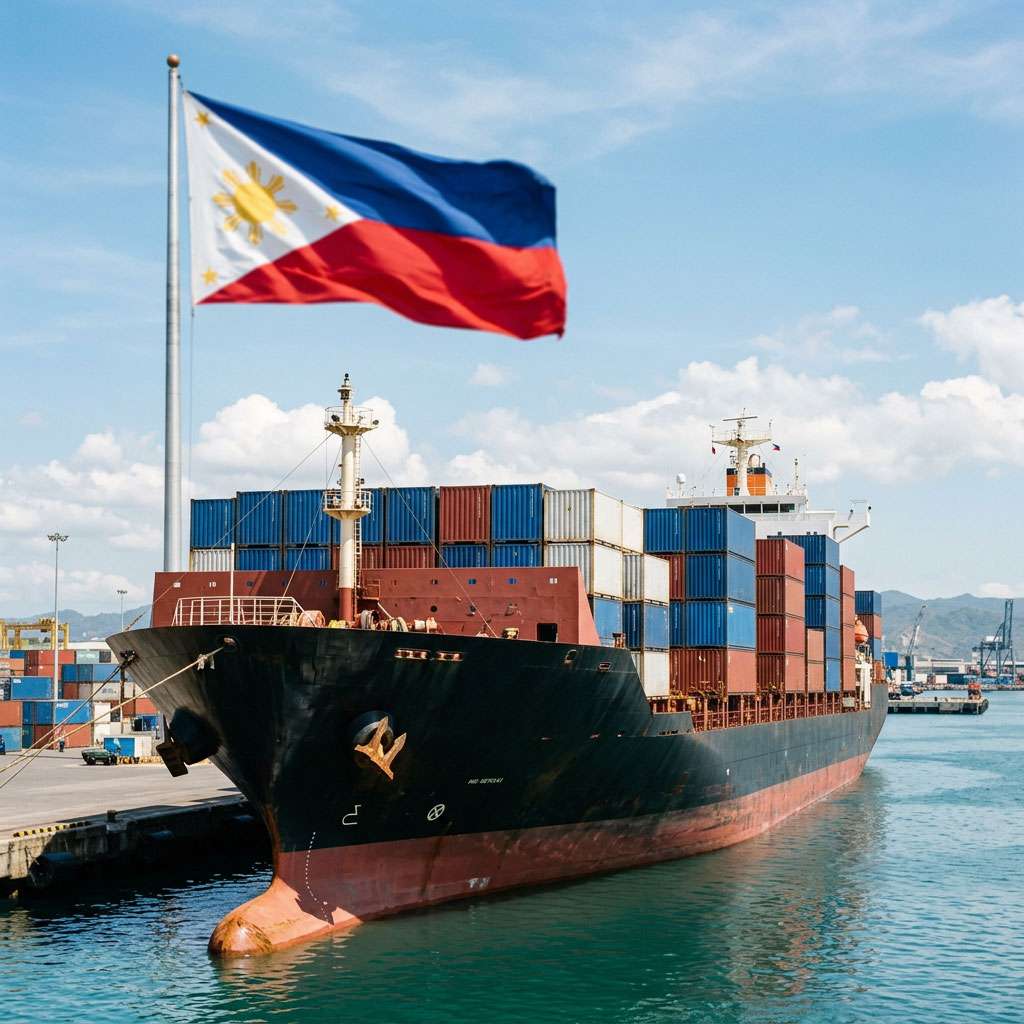
The rate for sea shipping from the Philippines depends on the port of loading, container type, nature of the cargo, and current congestion at the transshipment hub. Below are approximate current ranges; the manager calculates the exact rate for a specific shipment and confirms it in a commercial proposal.
Container Shipping (FCL)
| Port of Loading | 20′ DV | 40′ HC | Port of Arrival | Transit |
|---|---|---|---|---|
| Manila | from $4,300 | from $5,800 | Vladivostok | 28–35 days |
| Cebu | from $4,500 | from $6,000 | Vladivostok | 30–38 days |
| Manila | from $5,200 | from $7,100 | Novorossiysk | 40–50 days |
| Manila | from $5,400 | from $7,400 | St. Petersburg | 45–55 days |
Consolidated Cargo (LCL), CFS/CFS terms
| Port of Loading | 0.01–3.99 cbm/t | 4–6.99 cbm/t | from 7 cbm/t | Transit to Russia | Sailings |
|---|---|---|---|---|---|
| Manila | $85 | $80 | $75 | from 18 days | once a week |
| Cebu | $110 | $105 | $100 | from 21 days | once a week |
The rates are approximate and do not constitute a public offer. Current pricing for today is available upon request.
What Makes Up the Freight Cost
Consolidated cargo is charged on a W/M (weight/measurement) basis: both weight in tons and volume in cubic meters are calculated, and the higher figure is used for billing. A shipment of 2 m³ weighing 3 tons will be charged as 3 freight units, not 2. That’s why for dense cargo — hardware, ceramics, canned goods — the savings on LCL disappear faster than they seem to.
In addition to the freight rate itself, the delivery budget includes:
- transport of the cargo from the supplier to the consolidation warehouse and internal logistics between islands;
- terminal handling charges at the port of origin (THC), bill of lading processing, export declaration;
- transshipment at the hub and, in case of container delay, demurrage and detention;
- handling at the Russian port, bonded warehouse (SVKh), loading and unloading operations;
- customs payments: duty, VAT, customs fees;
- delivery from the port to the recipient’s warehouse — by road or rail transport.
We provide a full cost breakdown across all items at once, not just the freight rate — so that the final landed cost of the goods at the warehouse is known before signing the contract with the supplier.
Customs Clearance for Cargo from the Philippines
Customs clearance is WestComTrans’s core specialization. We hold the status of a certified customs representative and declare cargo under our own seal, without engaging third-party brokers: this eliminates situations where the logistics provider and the declarant shift responsibility onto one another.
Our work includes selecting the HS code, a preliminary calculation of payments before shipment, preparing and submitting the declaration to the Electronic Declaration Center, handling inspections and inspector inquiries, obtaining permits and certificates of conformity, and working on customs value adjustments.
Documents for Import from the Philippines
- Foreign trade contract with all appendices.
- Commercial invoice.
- Packing list.
- Bill of Lading.
- Export declaration of the country of export.
- Manufacturer’s price list.
- Payment documents for the contract.
- Certificate of origin — Form A is required for preferences.
- Phytosanitary certificate, veterinary certificate, or health certificate — depending on the product category.
- Technical description, product photographs, safety data sheet.
Tariff Preferences: How to Legally Reduce the Duty
The Philippines is included in the list of developing countries eligible for the EAEU’s unified system of tariff preferences. For goods included in the preferential list, provided a correctly issued Form A certificate of origin is available, the import duty is applied at 75% of the base rate.
The difference in practice: a shipment of coconut oil with a customs value of 3,000,000 ₽ at a base rate of 5% results in a duty of 150,000 ₽. With the preference — 112,500 ₽. That’s a savings of 37,500 ₽ on a single shipment, given that the certificate is issued by the supplier for free or for a nominal fee.
We verify eligibility for the preference before shipment and give the supplier advance instructions to issue Form A correctly — with an accurate product description and correct reference to the invoice. An error in the certificate means the preference is denied and additional payment is required after clearance.
Advantages of Working with Us
- One operator — one point of responsibility. We don’t hand off the cargo between different contractors: we organize the entire route from pickup at the supplier’s location in the Philippines to delivery at a warehouse in Russia.
- 10+ years in the international logistics market, specializing in customs clearance and container shipping.
- Multimodal capability — we combine sea, road, and rail transport to optimize final costs and timelines.
- Transparency at every stage — we keep you updated on cargo status without you needing to request information yourself.
- Handling any volume — from a consolidated pallet to a full container and oversized cargo.
We transport the following goods:

Chemical raw materials and components

Pharmaceutical products

Electronics and equipment

Textile products

Food products and spices

Construction materials

Clothing and footwear

Industrial equipment

“The Philippines is a route where the timeline breaks down not at sea, but during transshipment. There are no direct services to Russia, and the container always has to pass through Singapore, Busan, or Qingdao. If the booking is made as an afterthought, the shipment simply gets rolled to the next sailing — and the stated 30 days turns into 45. We select the right line combination for each specific shipment and keep every transshipment under control, so the timeline the client sees in the quote is an actual timeline, not a wish.” – Alexander Morozov, Logistics Specialist at WestComTrans
If you have any questions about the process of organizing container shipping from Philippines, or would like to get a consultation, feel free to reach out to us. We’re ready to help you at every stage of your cargo’s delivery!
WestComTrans – International Logistics.
COST OPTIMIZATION

Optimization of clearance and freight costs

Savings on terminal services

Adjustment of customs value

Optimization of final costs
Specify the email address to which we will send the cost calculation
SERVICE

24/7 communication with manager

Deferred payment

We work with and without VAT

Electronic document flow

Correspondence with sender

No hidden fees

Cargo insurance

Full support from purchase to delivery
Specify the email address to which we will send the cost calculation
WE ARE ALREADY TRUSTED


REVIEW


Ответы на частые вопросы
From 28 to 35 days to Vladivostok, 40–50 days to Novorossiysk, and 45–55 days to St. Petersburg. The multimodal “sea + rail” scheme delivers cargo to Moscow in 30–40 days. The exact timeline depends on the line’s schedule and the transshipment hub.
No. All shipments travel with transshipment at Asian hubs — Singapore, Busan, Qingdao, or Ningbo. The choice of hub directly affects the timeline and the risk of container delay, so the route is selected individually for each shipment.
We accept consolidated cargo from 0.1 m³ — that’s a single box. For regular and large shipments, a separate container is more cost-effective: the break-even point starts at around 13–15 m³.
The basic package: contract, invoice, packing list, bill of lading, export declaration, price list, and payment documents. Obtaining the tariff preference requires a Form A certificate of origin; food and plant products require phytosanitary or veterinary documents.


