


 China
 India
 Vietnam
 Thailand
 Taiwan
 UAE
 Israel
 Indonesia
 Turkey
 Italy
 Egypt
 Bangladesh
 Iran
 UK
 Algeria
 Tunisia
 Spain
 Malaysia
 Morocco
 Saudi Arabia
 Singapore
 Philippines
 China
 UAE
 Japan
 South Korea
 Taiwan
 United Kingdom
 Brazil


Meat Customs Clearance
Full-cycle customs clearance of beef, pork, lamb, and poultry — HS code, veterinary control, payment calculation, and delivery with temperature control maintained. We work with legal entities, managing the shipment from contract through to unloading at your warehouse.
✔ Release on the day the declaration is submitted with a complete document package
✔ Multimodal transport: sea, road, rail, air
✔ Over 10 years in the market
✔ We work throughout Russia and the EAEU
Specify the email address to which we will send the cost calculation.
Importing beef, pork, lamb, or poultry and need a customs broker who’s accountable for the outcome, not just someone who files the declaration? WestComTrans handles the full cycle: from determining the HS code and calculating payments to veterinary control and cargo release — with delivery by sea, road, rail, or a multimodal scheme, maintaining temperature control at every stage. We work with legal entities, with an average clearance time of 1 business day given a complete document package.
What’s Included in Meat Customs Clearance Service
- A personal manager handles the shipment from contract through to declaration release
- Verification of the invoice, packing list, and transport and veterinary documents before the cargo arrives
- Selection of the exact 10-digit HS code based on the type of meat, cut, and processing method
- Preliminary calculation of duty, VAT, and the customs fee
- Receiving the shipment at a refrigerated bonded warehouse (SVKh) and arranging inspection
- Coordination with customs and Rosselkhoznadzor, including confirmation of customs value
- Submitting the declaration and releasing the goods into free circulation
- Arranging further transport of the cargo via refrigerated transport
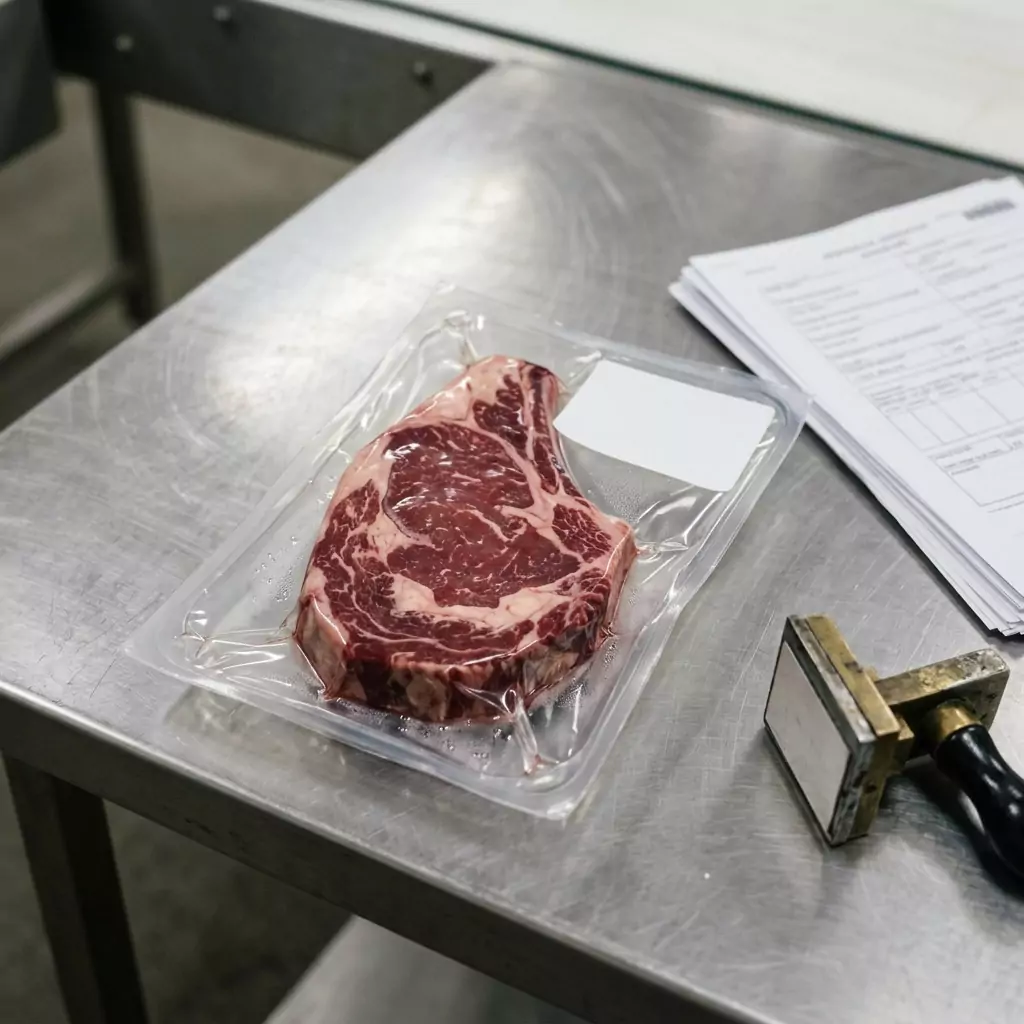
Special Considerations and Timelines for Meat Customs Clearance
Meat is a perishable product, so customs handles these shipments on a priority basis. With a complete and correct document package, the declaration is released within 1 business day. An error in the documents — an incorrectly stated weight, a mismatch between the shipment listed in the invoice and the veterinary certificate, or a missing temperature regime in the waybill — extends the clearance time and adds storage costs at the bonded warehouse (SVKh).
Three factors that most often affect speed:
- Temperature regime. Must be explicitly stated in the transport waybill. Without it, the temporary storage warehouse disclaims responsibility for the cargo’s condition.
- Veterinary control. Mandatory for all meat shipments without exception, carried out immediately after import and before the declaration is submitted.
- Customs value. Understating the value relative to the market level for a specific code and country of origin is a common cause of additional review and delayed release.
HS Code and Meat Classification
Raw, chilled, and frozen meat falls under group 02, while processed meat products (sausages, canned goods, ready meals) fall under group 16. The final 10-digit code depends on the type of animal, the cut, the processing method (chilling, freezing, deboning), and the purpose of the shipment.
Meat Types and Cuts That Affect the Code
Fresh or chilled beef is classified under position 0201, frozen beef under 0202, pork under 0203, lamb and goat meat under 0204, poultry meat and offal under 0207, and salted/dried/smoked meat under 0210. Within each position, the code differs by carcass, half-carcass, cuts (shoulder, leg, brisket, tenderloin), deboning, and the presence of a tariff quota — positions 0201, 0203, and 0207 have a tariff quota in certain cases, and importing within it requires a license from the authorized body.
Duty and VAT Rates by Meat Type
| HS Code | Product | Duty | VAT |
|---|---|---|---|
| 0201 10 000 1 | Fresh/chilled beef, carcasses and half-carcasses | 15% | 10% |
| 0202 10 000 2 | Frozen beef, carcasses and half-carcasses | 15% | 10% |
| 0210 19 900 0 | Other meat and offal, salted/smoked (pork) | 15%, but no less than €0.4/kg | 10%* |
| 0203, 0207 | Pork, poultry | depends on the specific 10-digit code and the presence of a tariff quota |
10%* |
*The reduced 10% VAT rate applies to meat and meat products, except for delicacies — tenderloin, veal, tongue, premium-grade raw-smoked and raw-cured sausages, smoked products (balyk, loin, neck, ham, pastrami, sirloin), roasted beef and pork, and canned goods (ham, bacon, jellied tongue). These are subject to the standard VAT rate — as of January 1, 2026, this is 22% (raised from 20% by Federal Law No. 425-FZ dated November 28, 2025).
We determine the exact code and rate for your shipment before dispatch — this locks in the calculation and rules out additional charges at customs.
Veterinary Control and Permits
Types of Veterinary Control on Meat Import
Carried out immediately after crossing the border, before the customs declaration is submitted:
- Documentary control — verification of the veterinary certificate from the country of dispatch and the Rosselkhoznadzor import permit
- Physical control (inspection) — checking labeling, number of packages, temperature regime, and manufacturer data against the accompanying documents
- Laboratory control — sampling if organoleptic deviations are detected, to rule out contaminated products
Following the inspection, the veterinary officer reissues the exporting country’s certificate as an EAEU-format certificate and applies the “Import Permitted” stamp. The supplier’s information must be in the “Argus” system for this: if the manufacturing plant has not yet been included in the Rosselkhoznadzor register, clearance will have to be suspended until this procedure is completed.
Permits and Certification
- Veterinary certificate from the country of origin, issued in two languages
- Declaration of conformity with the requirements of TR TS 034/2013 “On the Safety of Meat and Meat Products”
- Additionally — TR TS 021/2011 (food safety), 022/2011 (labeling), and for baby and specialized food — TR TS 027/2012
- Ministry of Industry and Trade license — when importing within a tariff quota
- Certificate of origin (CT-1, Form A) — if claiming tariff preferences
Documents for Meat Customs Clearance
- Foreign trade contract
- Invoice and packing list with net weight, gross weight, and type of packaging
- Transport waybill (CMR, air waybill, or bill of lading — depending on the route)
- Veterinary certificate from the country of dispatch
- Rosselkhoznadzor permit for importing regulated products
- Declaration of conformity with TR TS
- Certificate of origin — if applying preferences
- License — for shipments within a tariff quota
- Document confirming customs value
Transport and Storage of Meat: Temperature Control
We transport and store meat with precise adherence to the temperature regime at every stage — from loading through to handover at the bonded warehouse (SVKh):
- Chilled meat — 0…+2°C (for beef), for short and medium-distance transport
- Lightly frozen — from −5 to +5°C
- Frozen — no higher than −18°C, for longer international routes
We use refrigerated road vehicles, reefer containers, and insulated vans — all disinfected and inspected before every load. An important transport rule: frozen and chilled meat are not loaded into the same vehicle; cargo is packed tightly and securely fastened. Thanks to our own multimodal network, we can combine sea, road, rail, and air transport within a single route — this reduces both the timeline and the final delivery cost.
Sanctions and Current Meat-Supplying Countries
The food embargo on meat and meat products has been extended through the end of 2026. Imports are banned from: the USA, EU member states, the UK, Canada, Australia, Norway, Ukraine, Albania, Montenegro, Iceland, Liechtenstein, and New Zealand.
The main alternative suppliers of meat to the Russian market are Brazil, Argentina, India, China, Iran, Turkey, Vietnam, and Egypt. We handle clearance of shipments from these and other friendly countries directly.
Before processing a shipment, we check the country of origin and the manufacturer against the Rosselkhoznadzor register — this rules out a refusal of entry at the border and avoids losing time on perishable cargo.
How We Handle Meat Clearance: Stages of Work
- Request and analysis. You send us the invoice, contract, shipment details, and route — we determine the HS code, duty, VAT, and whether a quota applies
- Document gathering and verification. We cross-check the invoice, packing list, veterinary certificate, and permits before the cargo arrives
- Receipt at the bonded warehouse (SVKh). We receive the shipment at a refrigerated warehouse and arrange inspection and, if necessary, sampling
- Declaration submission. We complete and submit the customs declaration under the customs representative’s seal
- Coordination with customs and Rosselkhoznadzor. We respond to requests, confirm customs value, and support veterinary control
- Release and delivery. We hand over the document package and arrange further transport via refrigerated vehicles to the recipient’s warehouse
Why Choose Us
- Over 10 years in the market of international logistics and customs clearance
- Multimodal transport by sea, road, rail, and air — within a single route
- Working with one turnkey operator: no intermediaries and no blurring of responsibility between different contractors
- Door-to-door delivery with temperature control monitored at every stage
- Timely updates on cargo status at every stage of clearance
If you have any questions about the shipping container transportation process or would like to get advice, do not hesitate to contact us. We are ready to help you at every stage of your cargo delivery!
WestComTrans is an international logistics company.
COST OPTIMIZATION

Optimization of clearance and freight costs

Savings on terminal services

Adjustment of customs value

Optimization of final costs
Specify the email address to which we will send the cost calculation
SERVICE

24/7 communication with manager

Deferred payment

We work with and without VAT

Electronic document flow

Correspondence with sender

No hidden fees

Cargo insurance

Full support from purchase to delivery
Specify the email address to which we will send the cost calculation
WE ARE ALREADY TRUSTED


REVIEW


Ответы на частые вопросы
Yes, without exception. The certificate is issued in the country of dispatch in two languages and is a mandatory condition for passing veterinary control on import.
For most meat and meat products, the reduced rate of 10% applies. The exception is delicacies (tenderloin, veal, smoked products, certain canned goods): these are subject to the standard VAT rate of 22%, raised from 20% as of January 1, 2026.
With a complete and correctly prepared document package — 1 business day. Meat is among the products whose customs clearance is handled on a priority basis due to its limited shelf life.
The food embargo covers the USA, EU member states, the UK, Canada, Australia, Norway, Ukraine, Albania, Montenegro, Iceland, Liechtenstein, and New Zealand — extended through the end of 2026. Imports are possible from friendly countries — Brazil, Argentina, India, China, Iran, Turkey, and others — provided the manufacturer is included in the Rosselkhoznadzor register.


