


 China
 India
 Vietnam
 Thailand
 Taiwan
 UAE
 Israel
 Indonesia
 Turkey
 Italy
 Egypt
 Bangladesh
 Iran
 UK
 Algeria
 Tunisia
 Spain
 Malaysia
 Morocco
 Saudi Arabia
 Singapore
 Philippines
 China
 UAE
 Japan
 South Korea
 Taiwan
 United Kingdom
 Brazil


Turnkey Lentil Export from Russia
We ship red and green lentils by container, railcar or as a consolidated shipment. One operator handles customs, documents and delivery to the port or station of destination.
✔ Sea, rail, road, air, and multimodal solutions
✔ Customs clearance and permit documentation — turnkey
✔ 10+ years in international logistics
✔ Cost calculation within one business day
Specify the email address to which we will send the cost calculation
We organize lentil exports from Russia: we select the route and shipping format, file the export customs declaration, advise on the document set (SDIZ, the grain shipment accompanying document; phytosanitary certificate; certificate of origin) and deliver the lot to Turkey, Iran, Egypt and other countries. We calculate the route and the cost for each specific lot on the shipment date.
What Turnkey Lentil Export Includes
- Selecting the route and mode of transport: sea, rail, road or a combination.
- Booking containers or railcars for the shipment date.
- Export customs clearance: HS code classification, the export customs declaration, calculation and payment of the export duty.
- Container stuffing with a liner bag.
- SDIZ in FGIS “Zerno” (“Grain”), the Federal State Information System for grain.
- Laboratory tests, phytosanitary control and disinfestation, if the country or the contract requires it.
- Certificate of origin.
- Delivery to the port or station of destination, with updates at every stage along the way.
One transport operator manages the chain from the warehouse to the buyer. You do not have to coordinate contractors with each other, and responsibility between them is not split.
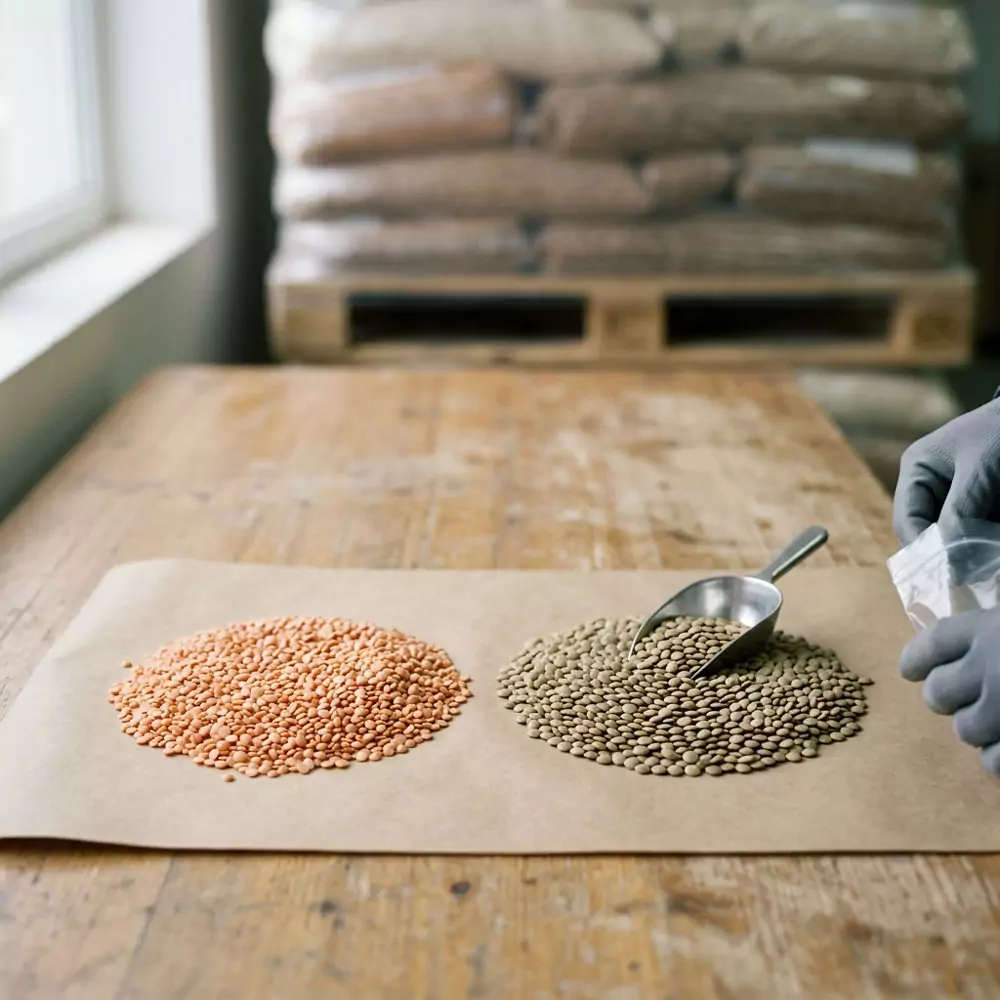
Container, Railcar or Vessel: How to Ship Lentils
The format depends on the volume, the type of lentils and the destination. A container suits lots from one container up, and especially polished or split red lentils. They have no hull and are more sensitive to moisture than green lentils, and a closed container with a liner bag protects them along the whole route. A covered railcar is convenient for deliveries to Central Asia and Afghanistan, and for bringing cargo to a port from Siberia and the Volga region.
Large bulk lots go on river-sea vessels or bulk carriers, for example to Iran across the Caspian. A container can be carrier-owned (COC) or the shipper’s own (SOC). The transport document depends on the mode of transport: a bill of lading by sea, an SMGS waybill (the international rail consignment note) by rail, and a CMR note by road.
Comparison of Shipping Methods
| Parameter | Container | Railcar | Bulk Vessel | Consolidated Shipment |
|---|---|---|---|---|
| Lot size | from one 20-foot container | railcar lot | large bulk lot | less than a container, trial lot |
| Packaging | 25–50 kg bags, big bags, bulk in a liner | bags, big bags in a covered railcar | bulk | bags, big bags |
| Destinations | Turkey, Egypt, India, UAE, Iran | Central Asia, Afghanistan, feeder runs to ports | Iran across the Caspian, Turkey | Turkey, Egypt, India, UAE, Iran |
| Cargo Safety and Risks | the container is closed and sealed; risk of condensation when the temperature changes | transloading at the border or in port, risk of wetting during transshipment | the lot sits in one hold, harder to protect from moisture | compatibility with neighboring cargo in odor and humidity |
A Small Lot: Consolidated Shipment
If a lot is not enough for a full container, or the buyer takes a trial lot, it goes as a consolidated shipment. Several shippers share the space in a container, and each pays only for its own part of the freight. We handle consolidated cargo. Before shipping lentils in bags or big bags, we check what they will travel with: the neighboring cargo must not pass its odor or moisture to the lentils. We prepare the document set separately for each lot.
Cost and Transit Time: What the Calculation Includes
We calculate the cost for each specific lot and shipment date, because freight and transshipment rates change. The total depends on:
- volume and packaging;
- mode of transport and route;
- the Incoterms 2020 rule;
- freight and carrier rates on the shipment date;
- transshipment and storage at the port or station;
- laboratory tests and phytosanitary control;
- disinfestation, if the country or the contract requires it;
- customs clearance;
- 5% export duty on the customs value;
- cargo insurance.
Transit time is made up of the time for documents and the time in transit. The Incoterms rule determines who pays for the main carriage and where the risk passes to the buyer.
| Incoterms Rule | Who Pays for the Main Carriage | Where the Risk Passes to the Buyer |
|---|---|---|
| FCA | buyer | when the goods are handed to the buyer’s carrier at the agreed place |
| CPT | seller, to the place of destination | when the goods are handed to the first carrier |
| CIP | seller, plus cargo insurance | when the goods are handed to the first carrier |
| FOB | buyer | after loading on board the vessel at the port of loading |
| CFR | seller, to the port of destination | after loading on board the vessel at the port of loading |
| CIF | seller, plus cargo insurance | after loading on board the vessel at the port of loading |
For container shipments, the ICC recommends FCA, CPT and CIP. FOB, CFR and CIF are designed for sea transport and suit bulk cargo. If a container is delivered to the terminal under FOB, the risk stays with the seller until loading on board, even though the cargo is no longer in the seller’s hands.
Red and Green Lentils: What the Lot Should Look Like
Two main types of lentils are exported (Lens culinaris): red lentils, polished or split, and green plate-type lentils, large-seeded and small-seeded. The buyer sets the sizing, moisture, weed and grain impurities in the contract, and a laboratory checks them before shipment. Export lots are tested, among others, by the FGBU “TsOK APK,” an institution under Rosselkhoznadzor (the Russian Federal Veterinary and Phytosanitary Surveillance Service).
The main harvest comes from the Saratov region and Altai Krai, and lentils are also grown in the Orenburg, Omsk and Volgograd regions. From Siberia and the Volga region, lots go by rail to a seaport or directly to Central Asia.
Quality Under GOST 7066-2019 and the Laboratory
Green plate-type lentils are assessed under GOST 7066-2019 “Food Plate-Type Lentils. Specifications,” in force since 1 November 2020. The main limits:
- moisture — no more than 15.0%;
- weed impurities — no more than 0.5%;
- grain impurities — no more than 3.5%;
- seeds with live pests — not permitted.
The standard covers plate-type lentils only. Polished or split red lentils are made to the producer’s technical specifications or company standard, and for export the reference point is the contract specification. If a contract for red lentils refers to GOST 7066-2019, it is better to write the parameters out separately: this standard does not apply to red lentils.
Packaging and Protection from Moisture
Lentils are shipped in 25–50 kg polypropylene or paper bags, in big bags, or in bulk in a container with a liner bag. The main risk in transit is condensation when the temperature changes. It is reduced with a dry, clean container, a moisture check of the lot before container stuffing, kraft liner along the walls and silica gel sorbents.
We build protection from spoilage and the transport regime into the shipping plan.
Duty, HS Code and Documents for Lentil Export
5% Export Duty and Code 0713 40 000 0
Lentils are declared under code 0713 40 000 0 of the EAEU customs nomenclature (TN VED, based on the HS), “lentils, dried, shelled.” We explain how classification works in the article “What Is an HS Code”.
Since 1 January 2025, a 5% export duty on the customs value has applied to exports outside the EAEU, with no end date set. The item was added to the list under Government Decree of 27 November 2021 No. 2068 by Decree of 27 December 2024 No. 1929; before that, exchange-rate-linked duties applied. The zeroing of duties on wheat, barley and corn under Government Decree No. 1194 of 19 September 2026 does not apply to lentils: the rate for them is unchanged. For deliveries to EAEU countries, the export duty does not apply. We check the rate on the shipment date when we calculate.
SDIZ and FGIS “Zerno” (“Grain”)
Lentils are a pulse crop, and their lots are recorded in FGIS “Zerno” (“Grain”), the Federal State Information System for grain. Export requires an SDIZ, the grain shipment accompanying document, confirmed by Rosselkhoznadzor. The basis is Government Decree of 9 October 2021 No. 1721, as amended by Decree of 7 February 2026 No. 97. An SDIZ without Rosselkhoznadzor confirmation is invalid.
Phytosanitary Certificate and Disinfestation
Rosselkhoznadzor issues the phytosanitary certificate for each lot after quarantine phytosanitary control and laboratory tests. The application is submitted electronically through the “My Export” portal (the “Single Window” state information system). The lot must cross the border within 30 days of the date the certificate is issued (Order of the Ministry of Agriculture of Russia of 12 January 2022 No. 7). If a container waits a long time for a vessel in port, this period may end before the lot leaves.
Disinfestation (fumigation) is not needed on every route: the importing country or the contract requires it. Against quarantine pests, lentils are treated with phosphine-based products or methyl bromide, and a separate disinfestation certificate is issued after treatment.
Documents for Lentil Export
- foreign trade contract;
- invoice and packing list;
- SDIZ;
- phytosanitary certificate;
- disinfestation certificate — if the country or the contract requires it;
- general-form certificate of origin or Form CT-1 — for CIS free trade area countries outside the EAEU;
- export customs declaration;
- transport document: bill of lading, SMGS waybill or CMR;
- laboratory test results or a quality certificate — at the buyer’s request.
How a Shipment Works: From Request to Arrival
- Request and quote: type of lentils, volume, packaging, destination country, Incoterms rule.
- Check of the importing country’s requirements and the contract: phytosanitary requirements, treatment, document set.
- SDIZ in FGIS “Zerno” (“Grain”).
- Laboratory tests, inspection and the phytosanitary certificate; disinfestation, if needed.
- Container or railcar stuffing and sealing.
- Export customs declaration and payment of the 5% export duty.
- Transport and tracking, and we notify you at every stage.
- Arrival and handover of documents to the buyer.
Advantages of Working With Us
- Over 10 years in the international logistics market — an established network of agents and partners worldwide
- One operator instead of a chain of subcontractors — you work with a single company at every stage, instead of coordinating separately with the carrier, customs broker, and freight forwarder
- Single point of responsibility — WestComTrans is accountable for the cargo from warehouse pickup all the way to delivery to the recipient
- Competitive pricing through route optimization — we combine transport types to eliminate unnecessary costs
- Timely updates at every stage — you always know where your cargo is
- Full turnkey support — from cost calculation to closing documents
We transport the following goods:

Chemical raw materials and components

Pharmaceutical products

Electronics and equipment

Textile products

Food products and spices

Construction materials

Clothing and footwear

Industrial equipment

“A phytosanitary certificate gives the lot 30 days to cross the border, and the vessel does not change its schedule to fit the certificate. So I look at the booking first and only then at the sampling date. If sampling is set earlier than the loading is confirmed, the time margin shrinks before the container has even left the warehouse.” – Alexander Morozov, Logistics Specialist at WestComTrans
If you have any questions about the process of organizing international export shipping of lentil from Russia, or would like to get a consultation, feel free to reach out to us. We’re ready to help you at every stage of your cargo’s delivery!
WestComTrans – International Logistics.
COST OPTIMIZATION

Optimization of clearance and freight costs

Savings on terminal services

Adjustment of customs value

Optimization of final costs
Specify the email address to which we will send the cost calculation
SERVICE

24/7 communication with manager

Deferred payment

We work with and without VAT

Electronic document flow

Correspondence with sender

No hidden fees

Cargo insurance

Full support from purchase to delivery
Specify the email address to which we will send the cost calculation
WE ARE ALREADY TRUSTED


REVIEW


Ответы на частые вопросы
5% of the customs value. The rate has applied since 1 January 2025 to code 0713 40 000 0 of the EAEU customs nomenclature (TN VED) for exports outside the EAEU (Government Decree of 27 December 2024 No. 1929). The zeroing of duties on wheat, barley and corn in September 2026 does not apply to lentils. We check the rate on the shipment date when we calculate.
Yes. Lentils are a pulse crop, their lots are recorded in FGIS “Zerno” (“Grain”), and export requires an SDIZ confirmed by Rosselkhoznadzor. The data in it must match the declaration and the transport documents, otherwise the release of the lot may be delayed.
30 days: within this time from the date of issue, the lot must cross the border (Order of the Ministry of Agriculture of Russia No. 7). The certificate is issued for each lot, so we plan container stuffing and shipment to fit within the period.
As of October 2026, no. The protocol on phytosanitary requirements for Russian lentils with GACC has not been signed, so lentil export from Russia to China is closed for now. When access opens, the requirements will appear on the Rosselkhoznadzor website.


