


 China
 India
 Vietnam
 Thailand
 Taiwan
 UAE
 Israel
 Indonesia
 Turkey
 Italy
 Egypt
 Bangladesh
 Iran
 UK
 Algeria
 Tunisia
 Spain
 Malaysia
 Morocco
 Saudi Arabia
 Singapore
 Philippines
 China
 UAE
 Japan
 South Korea
 Taiwan
 United Kingdom
 Brazil


Turnkey Barley Export from Russia
For grain producers and exporters: we handle export formalities, assemble the phytosanitary documents and deliver the shipment to the destination port. One operator is responsible for the whole shipment.
✔ Sea, rail, road, air, and multimodal solutions
✔ Customs clearance and permit documentation — turnkey
✔ 10+ years in international logistics
✔ Cost calculation within one business day
Specify the email address to which we will send the cost calculation
We help grain producers, traders and exporters organize barley exports from Russia. We select the route and shipping format, prepare the export customs declaration, assemble the phytosanitary documents and deliver the shipment to Iran, Turkey, Saudi Arabia, Egypt and China. We plan each route around current port workload, not a template.
What We Handle in a Barley Export
- Route and format selection: container, railcar or vessel.
- Booking of 20DV/40HQ containers and railcars.
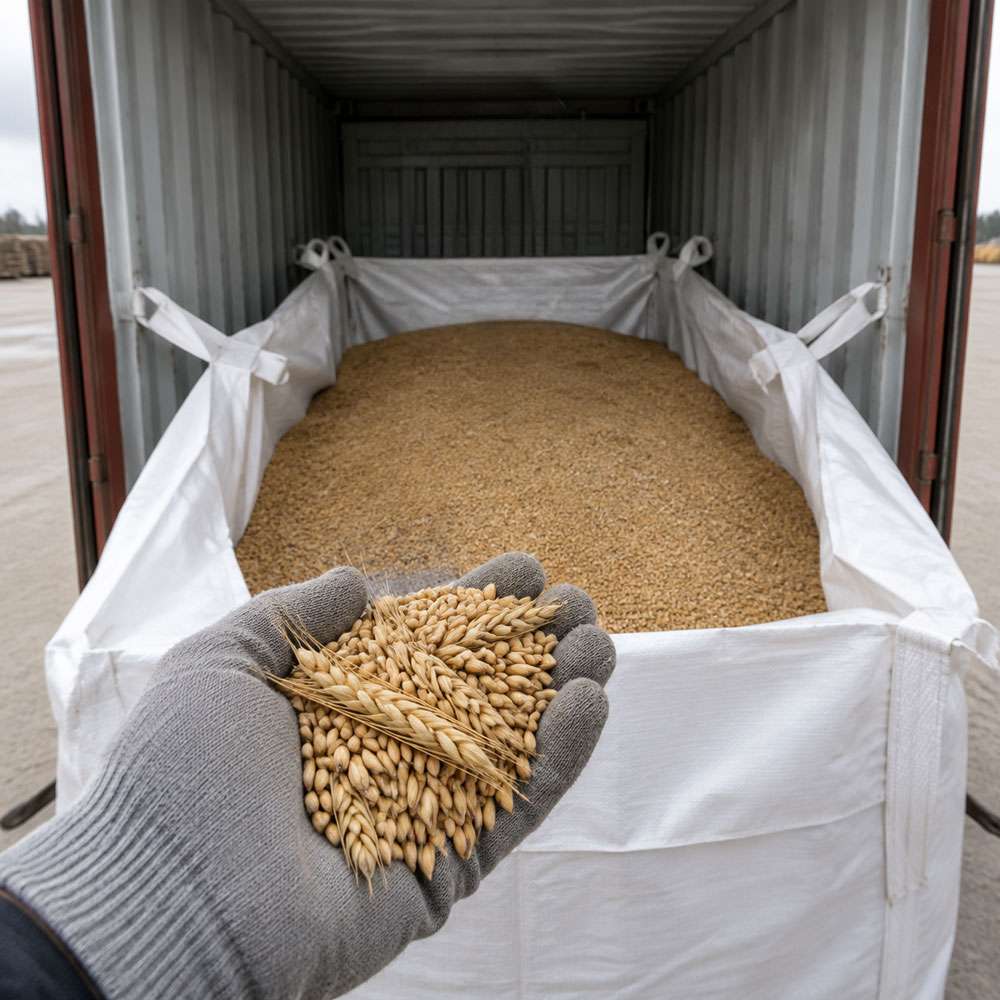
- Loading barley into containers with a liner bag.
- Customs clearance: export customs declaration, HS code, documents for currency control at the bank.
- Phytosanitary control and disinfestation of the shipment.
- Quality and weight survey at loading.
- Delivery to the destination port or station.
- Status updates at every stage of transport.
Container, Vessel or Railcar: How to Ship Barley
A container suits shipments that start from a single container, where the buyer has no grain terminal of its own. Bulk by sea pays off for large lots going to a country with grain terminals. For China and Central Asian countries, railcars are the main option. The end use of the barley also matters. Feed, malting and food barley are tested against different parameters, so the end use determines the packaging format and the cleanliness requirements for the hold or container.
| Parameter | Container with Liner Bag | Bulk Vessel | Hopper Railcar |
|---|---|---|---|
| Minimum lot | from 1 container | vessel lot of several thousand tonnes | from 1 railcar |
| Best suited for | small and mid-size lots, buyers without a grain terminal, delivery to a warehouse | large lots to countries with grain terminals | China, Central Asia, feeder haul to a port |
| Loading | filling the liner bag at a site or an elevator | accumulating the lot at the elevator, loading into the hold at the terminal | gravity loading from the elevator into the hopper |
| Main risks | container detention, condensation on a long transit | vessel demurrage, terminal queues, draft restrictions | railcar shortage in season, waiting at the border crossing |
| Transit time | from 28 days | from 28 days | from 28 days |
Containers with Liner Bags for Lots from One Container
Barley is loaded into a 20DV or 40HQ container with a liner bag fixed inside. The grain does not touch the walls, and the liner is removed after unloading, so the container is easier to prepare for return. If the buyer needs packed cargo, the barley is bagged in big bags or 25–50 kg sacks.
A container scheme does not require building up a vessel lot at the elevator. You can send a single unit and deliver it to the buyer’s warehouse. This is our core specialization, together with customs clearance.
Ways to Transport Wheat for Export
The choice of transport depends on shipment volume, destination, and wheat class. We select the scheme that gives the lowest cost per ton while meeting contract deadlines.
| Mode of Transport | Min. Shipment | Typical Timelines | When It’s Used |
|---|---|---|---|
| Sea, bulk (bulk carrier) | from 3,000 t | 4–20 days | Large contracts to Egypt, Turkey, African countries |
| Sea, in containers (liner bag) | from 1 container (20 ft) | 15–40 days | Durum wheat, Southeast Asian countries, shipments up to 5–10 containers |
| Rail (hopper car) | from 1 railcar (~65 t) | 5–15 days | Shipments to transshipment ports or directly to CIS countries |
| Road | from 1 truck (~25 t) | 2–7 days | Short legs, urgent small shipments |
Sea Shipping of Wheat, Bulk and in Containers
For industrial volumes, we charter Panamax and Handysize class bulk carriers from deep-water ports — Novorossiysk, Taman, Tuapse. This is the primary route for shipments to Egypt, Saudi Arabia, and African countries. For shallow-water ports (Azov, Rostov-on-Don, Astrakhan), we select mixed-navigation vessels with a capacity of 3,000–5,000 t — convenient for exports to Turkey and Iran. High-class durum wheat and shipments destined for Southeast Asia are sent in 20-foot containers using liner-bag technology — in bulk, with no repacking into sacks.
Rail and Road Shipping
We supply hopper cars to the loading station, coordinate the transport plan, and pay the rail tariff. This method is used for delivering shipments to a transshipment port or directly to CIS countries. We use road transport for short legs and small urgent shipments, as well as a connecting link in multimodal schemes — for example, moving cargo from the elevator to the station or port.
Bulk Vessel Shipments
Lots of several thousand tonnes and more go on bulk carriers (Handysize, Panamax) from deep-water ports. Azov, Rostov-on-Don and Astrakhan are shallow, and Panamax vessels do not load there, so barley from these ports moves on river-sea vessels. We calculate such shipments on request.
Rail and Multimodal Routes
To China and Central Asia, barley moves in hopper railcars (grain wagons) or in containers on flatcars. Transport is documented on an SMGS rail waybill, and loading applications are submitted through ETRAN, the electronic system for rail freight orders. On sea routes, a multimodal scheme works: railcar to the port, then transfer to a vessel or a container. We combine the legs to reduce cost and avoid dependence on a single port.
Duty, Quota and HS Code for Barley in 2026
Barley is classified under heading 1003 of the EAEU CN FEA (the Eurasian Economic Union’s commodity nomenclature, based on the HS): 1003 10 is seed barley, and 1003 90 000 0 is other barley, that is, commercial barley. We explain how to select the code in the article “What Is an HS Code”.
The export duty on grain is floating, and the rate is recalculated weekly. The indicative price under export contracts is compared with a base price, and the duty is 70% of the difference. The Ministry of Agriculture publishes the rates in advance. A special regime applies now: under Russian Government Decree No. 1194 of 19 September 2026, the duty on barley, wheat, meslin and corn exported outside the EAEU is set at zero from 1 September to 31 December 2026. We confirm the rate for later shipments when we prepare your quote.
In 2026, the tariff quota for grain exports outside the EAEU ran from 15 February to 30 June: 20 million tonnes under Decree No. 2089 of 22 December 2025 and a further 5 million tonnes of additional quota under Decree No. 393 of 10 April 2026. The Ministry of Agriculture allocates the quota among exporters. Volumes above the quota pay a higher rate: 50% of the customs value, but not less than EUR 100 per tonne. For grain produced in the Donetsk and Luhansk People’s Republics and the Zaporozhye and Kherson regions, separate quotas are set for 2026 (Decree No. 2106 of 23 December 2025). We plan February–June shipments with the quota for the relevant year in mind.
| Period | Regime |
|---|---|
| 1 September 2026 – 31 December 2026 | zero export duty on barley |
| 15 February – 30 June (in 2026) | quota period: export within the quota, higher rate above it |
Buyer Country Requirements
Before loading, we check the requirements of the destination country. Each importer has its own phytosanitary conditions, and Rosselkhoznadzor (the Russian Federal Veterinary and Phytosanitary Surveillance Service) publishes them by country. An error found at the discharge port costs more to fix than one found at the elevator.
China: Spring Barley Only
Under the protocol between Rosselkhoznadzor and GACC (the General Administration of Customs of China) dated 5 June 2019, with an addendum published in 2022, only spring barley may be exported to China. It is stored and transported separately from winter barley. The elevators and other facilities that handle the lot must be on the list approved by GACC. A common mistake is to check only the exporter against the list and not the elevator where the lot was stored.
The regional restriction was lifted in 2022. Barley can be shipped from anywhere in Russia, provided the grain is grown in zones free of dwarf bunt of wheat. As of October 2026, winter barley is not approved, and Rosselkhoznadzor has sent documents for its approval to the Chinese side. Demand is there: in January–September 2026, China bought Russian barley worth USD 134.5 million (GACC data).
Other Destinations
- Iran: we check the lot against Iran’s phytosanitary requirements published by Rosselkhoznadzor.
- Turkey: we confirm the conditions on disinfestation and quarantine pests for your buyer and port.
- Saudi Arabia: we agree in advance the quality parameters that the buyer fixes in the contract.
- Egypt: we check the requirements for the phytosanitary certificate and laboratory tests before shipment.
Documents for Barley Export
- Foreign trade contract and invoice. They set the Incoterms basis, price and quality parameters. Prepared by the exporter.
- SDIZ, the grain shipment accompanying document. It is required for traceability and is issued in FGIS “Zerno” (“Grain”), the state grain information system.
- Export customs declaration. The basis for release for export, and we prepare it.
- Phytosanitary certificate. It confirms compliance with the destination country’s requirements. Issued by Rosselkhoznadzor at the place of dispatch, and the application is submitted through FGIS “Argus-Fito,” the phytosanitary certification system.
- Disinfestation act or certificate, if the country requires it. Issued by the organization that carried out the treatment.
- Certificate of origin: Form CT-1 for CIS countries, or a general form if the buyer requires it. Issued by the Chamber of Commerce and Industry.
- Quality and weight certificate. It records the parameters at loading and is issued by a surveyor or a laboratory.
- Transport documents: bill of lading, SMGS rail waybill or CMR. Issued by the carrier.
Phytosanitary Certificate and Fumigation: How to Avoid Delays
- Submit the application for the phytosanitary certificate in advance, before the loading date, not on the day of shipment.
- A certificate is issued for each lot.
- The certificate’s validity is limited: the lot must cross the border within 30 days of issue. The period runs until the border crossing, not until loading. If loading slips, the certificate can expire before the lot leaves the port, so the dates of disinfestation and sampling are tied to the loading schedule.
- Live pests found at the destination port are grounds for returning the lot. Treatment is carried out before loading and confirmed by a document.
Cost and Transit Time: What Makes Up the Price
The shipping price includes delivery to the port or station, loading, freight, disinfestation and laboratory tests, quality and weight survey, customs clearance, export duty (0 until 31 December 2026) and cargo insurance. Which of these items the exporter pays depends on the Incoterms 2020 basis.
| Term | Seller Is Responsible Up To | Who Pays Freight | Who Insures |
|---|---|---|---|
| FCA | handing the cargo to the buyer’s carrier at the agreed place | buyer | buyer, at its discretion |
| FOB | loading on board the vessel at the port of shipment | buyer | buyer, at its discretion |
| CFR | loading on board; the seller pays freight to the destination port | seller | buyer, at its discretion |
| CIF | loading on board; the seller pays freight and insurance to the destination port | seller | seller (minimum cover, unless the contract requires more) |
For container shipments, the International Chamber of Commerce recommends using FCA, CPT and CIP instead of FOB, CFR and CIF.
Transit time depends on the route, the format and port workload on the shipment date. A separate risk is containers and vessels standing idle beyond free time.
How We Organize Your Shipment and Why It Works
- Request and route calculation.
- Check of country requirements and documents, choice of Incoterms basis.
- Booking of containers, railcars or a vessel.
- Loading, sampling, disinfestation.
- Customs clearance and phytosanitary certificate.
- Shipment and cargo tracking.
- Delivery and handover of documents to the buyer.
We have worked in international logistics for more than 10 years. You ask all questions about your shipment to one contact manager and receive a status update from them at every stage, with no correspondence with several contractors.
Where a Barley Export Can Go Wrong
- The phytosanitary certificate expires before export. We tie sampling and treatment to a confirmed loading date.
- Containers or the vessel stand idle. We book transport against a ready lot and documents, so you do not pay demurrage and detention.
- Railcars run short in season. We submit applications early and keep a fallback option through containers.
- Shallow waters of the Caspian. When choosing a vessel and planning its load, we take draft restrictions into account.
- Weight or quality differs at the destination port. The parameters are recorded by a survey at loading, so any dispute is settled on the basis of a document.
Advantages of Working With Us
- Over 10 years in the international logistics market — an established network of agents and partners worldwide
- One operator instead of a chain of subcontractors — you work with a single company at every stage, instead of coordinating separately with the carrier, customs broker, and freight forwarder
- Single point of responsibility — WestComTrans is accountable for the cargo from warehouse pickup all the way to delivery to the recipient
- Competitive pricing through route optimization — we combine transport types to eliminate unnecessary costs
- Timely updates at every stage — you always know where your cargo is
- Full turnkey support — from cost calculation to closing documents
We transport the following goods:

Chemical raw materials and components

Pharmaceutical products

Electronics and equipment

Textile products

Food products and spices

Construction materials

Clothing and footwear

Industrial equipment

“Often it is not the quality of the grain that lets a shipment down, but the calendar. A phytosanitary certificate is counted until the border crossing, not until loading. If loading slips, a certificate issued with a margin can expire before the lot leaves the port. That is why we try to fix the loading date before the sampling date.” – Alexander Morozov, Logistics Specialist at WestComTrans
If you have any questions about the process of organizing international export shipping of barley from Russia, or would like to get a consultation, feel free to reach out to us. We’re ready to help you at every stage of your cargo’s delivery!
WestComTrans – International Logistics.
COST OPTIMIZATION

Optimization of clearance and freight costs

Savings on terminal services

Adjustment of customs value

Optimization of final costs
Specify the email address to which we will send the cost calculation
SERVICE

24/7 communication with manager

Deferred payment

We work with and without VAT

Electronic document flow

Correspondence with sender

No hidden fees

Cargo insurance

Full support from purchase to delivery
Specify the email address to which we will send the cost calculation
WE ARE ALREADY TRUSTED


REVIEW


Ответы на частые вопросы
No. From 1 September to 31 December 2026, the rate is zero (Decree No. 1194 of 19 September 2026). The zero rate applies to barley exported outside the EAEU. For shipments from 1 January 2027, we confirm the rate on the shipment date when we calculate your lot.
No. China accepts only spring barley, and it must be stored separately from winter barley. The second condition applies to the whole chain: the elevators and other facilities that handle the lot must be on the list approved by GACC. We check both conditions before loading, so the lot is not stopped at the border.
A contract and invoice, SDIZ (the grain shipment accompanying document), an export customs declaration and a phytosanitary certificate. If the country or the buyer requires it, a disinfestation act, a certificate of origin and a quality and weight certificate are added. We send the list for your destination together with the quote.
According to the Russian Grain Union, in October 2026 all barley exported through ports went to Iran, and most grain moved through Baltic ports. For Iran, the working option is the Caspian; for distant destinations, the Baltic; for China, rail. We confirm the route for your lot before booking, based on port workload on that date.


