


 China
 India
 Vietnam
 Thailand
 Taiwan
 UAE
 Israel
 Indonesia
 Turkey
 Italy
 Egypt
 Bangladesh
 Iran
 UK
 Algeria
 Tunisia
 Spain
 Malaysia
 Morocco
 Saudi Arabia
 Singapore
 Philippines
 China
 UAE
 Japan
 South Korea
 Taiwan
 United Kingdom
 Brazil


Demurrage and Detention in Container Shipping: What’s the Difference, How to Calculate Them, and How to Avoid Fees
In international container shipping, the total delivery cost rarely stops at freight and customs duties. If cargo is delayed at the port or a container isn’t returned to the carrier on time, companies charge additional fees — demurrage and detention. Let’s break down how they differ, how they’re calculated, and what actually helps avoid them.
What Demurrage Means in Simple Terms
Demurrage is a fee charged for keeping cargo in a container at a port or terminal beyond the free storage period. This free period is called “free time,” and it typically runs from 3 to 14 days — the exact duration is specified in the shipping contract and depends on the port, the shipping line, and the type of cargo.
Once free time expires, a daily rate is charged for each day of delay — in 2026, this is typically $30–150 per container, though on certain routes and for refrigerated containers the rate can reach $200+ per day. Many lines apply a progressive scale, where the longer the delay, the higher the daily rate. Demurrage specifically applies to cargo at the port: as long as the container hasn’t physically left the terminal, the delay clock keeps running.
Despatch — a Reward for Early Processing
There’s also the reverse situation: if loading or unloading is completed faster than the timeframe specified in the contract, the cargo owner may be paid a bonus — despatch. Despatch typically amounts to around 50% of the demurrage rate that would have applied for an equivalent delay. The despatch clause must be separately specified in the contract — it doesn’t apply by default.

What Detention Means and How It Differs from Demurrage
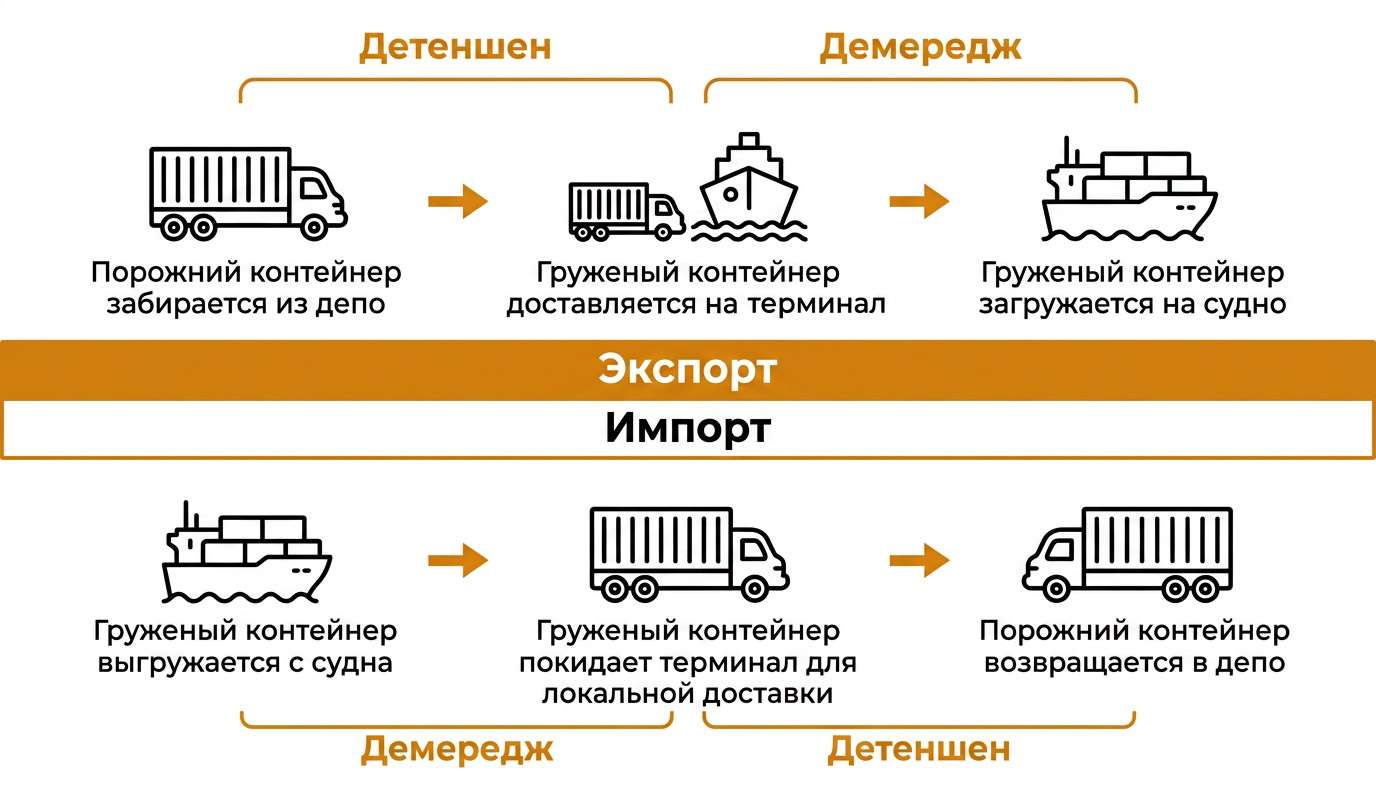
Detention is a fee for using a container outside the port after the free period for returning it to the carrier has expired. The key difference is this: demurrage accrues while the cargo is still at the port, whereas detention applies after the container has already been taken to the recipient’s warehouse but hasn’t been returned to the shipping line’s terminal within the agreed timeframe.
The free usage period for a container outside the port is typically 7–14 days. If the recipient doesn’t manage to unload the container and deliver it to the return terminal in time, each day beyond the limit is billed separately — usually $25–150 per day depending on the container type, and with extended delays under a progressive scale, the amount can grow considerably faster.
Demurrage vs. Detention: Side-by-Side Comparison
| Parameter | Demurrage | Detention |
|---|---|---|
| What’s being paid for | Cargo sitting idle at the port/terminal | Use of the container outside the port |
| Where it accrues | At the port, before the container is picked up | After pickup, before the container is returned to the line |
| Main cause | Customs clearance delays, documentation errors | Lack of transport, unloading delays at the warehouse |
| Who usually pays | The cargo recipient or the party under the contract | The recipient, freight forwarder, or container lessee |
| Average free period | 3–14 days | 7–14 days |
Legal Framework: What the Law Says
In Russian practice, demurrage is regulated by Articles 130–132 and 135 of the Merchant Shipping Code of the Russian Federation. The fee amount is determined by agreement between the parties, and in the absence of such a provision — by the rates customarily applied at the specific port; if no such rates exist either, the fee is calculated based on the vessel’s actual maintenance costs. An important nuance: demurrage isn’t a penalty in the legal sense, but compensation for the carrier’s or terminal’s losses — that is, a measure of civil liability rather than a punishment. Additionally, free time terms and penalty fees on international routes often reference Incoterms rules — but the specific rates and deadlines are in any case set by the shipping contract, not by Incoterms itself.
Why Demurrage and Detention Occur
More often than not, additional fees aren’t the result of a single cause but a chain of breakdowns at different logistics stages:
- Documentation errors. Inaccuracies in the invoice, packing list, or declaration take time to correct — and the cargo sits idle at the port the whole time.
- Additional customs inspection. Physical inspection, requests for missing permits, or clarification of customs value extend the clearance time, especially for imports.
- Lack of transport for pickup. If a truck or rail platform isn’t provided on time, the container stays at the terminal beyond free time.
- Delays at the recipient’s warehouse. Insufficient space for unloading or an uncoordinated cargo receiving schedule mean the container isn’t returned to the carrier on time — and detention starts accruing.
- Terminal congestion. During peak import seasons, ports may physically be unable to keep up with cargo flow, increasing the risk of delays even with careful documentation.
How Demurrage and Detention Are Calculated: Formula and Example
The basic formula is the same for both fees:
Fee amount = number of days beyond free time × daily rate
Many lines and terminals apply a progressive scale, where the longer the delay, the higher the rate. Example calculation of demurrage for a 40-foot container:
- Free time — 7 days (free).
- Days 8 through 14 — rate of $35/day → 7 × 35 = $245.
- From day 15 onward — the rate increases to $50/day.
If the container sat idle for 20 days total, that’s another 6 days at the higher rate → 6 × 50 = $300. - Total demurrage: 245 + 300 = $545.
Detention is calculated in the same way, but at a separate rate for using the container outside the port. For example, with 7 days of free time and a 3-day delay in return at a rate of $80/day, the amount would be 3 × 80 = $240.
How Demurrage and Detention Combine on Imports and Exports
The order in which fees are charged depends on the direction of the shipment:
- On imports, demurrage is charged first — while the cargo sits at the port after being unloaded from the vessel. Once the container is picked up, the demurrage clock stops and the detention clock starts — running until the empty container is returned to the carrier.
- On exports, the order is reversed: detention is calculated first — from the moment the exporter picks up the empty container for loading, until it’s returned to the port already loaded with cargo. Demurrage in this case is charged only after loading, if the vessel or terminal delays departure.
It’s important to clarify in the contract whether both fees are charged in parallel or sequentially — this directly affects the total amount in the case of extended delays.
How to Avoid Demurrage and Detention: Practical Recommendations
- Prepare documents in advance and in several copies. It’s better to check the invoice, packing list, bill of lading, and declaration before the vessel arrives, not after — this is the most common cause of delay.
- Clarify free time terms before booking. The duration and rates vary significantly between lines and terminals — sometimes it’s more cost-effective to choose a different carrier with a longer free period.
- Arrange transport and warehouse space in advance. Trucks for pickup and warehouse space should be ready by the time the container arrives, not organized after the fact.
- Negotiate an extended free time. With regular shipments, large shippers may be able to negotiate a longer free period — this is a matter of negotiation, not a fixed rule.
- Work with a single shipping operator. When customs clearance, transport, and forwarding are all handled by one company, the risk of inconsistency between contractors — and therefore the risk of delay — is reduced.
Specifics for Russian Ports and Multimodal Shipping
In practice, demurrage and detention terms vary noticeably even between Russian ports. Novorossiysk is one of the country’s key container hubs: in 2024, its container throughput exceeded 1 million TEU (up 6.5% year-on-year), and after 2022 the lineup of carriers operating there changed considerably — from the previous 18 shipping lines, the port was left with only 5 for a time, but the list is now actively expanding with new operators (RusCon, Lider Line, Amethist, and others). The free period on most lines here is around 10 days for standard dry containers and around 7 days for specialized equipment — reefers, Open Top, Flat Rack, and tank containers — and this distinction is often overlooked in planning.
The main import flow into Novorossiysk comes from China (Shanghai, Ningbo, Qingdao, Shenzhen), as well as via the “short leg” from Turkish ports (Istanbul, Mersin) — this route has been growing especially fast in recent years, alongside the route via Nhava Sheva in India. In multimodal shipments, a rail leg is added to the sea leg — and free time at rail terminals is typically shorter than at sea ports, running 1–3 days instead of the usual 7–10. This is especially important to factor in when building a “sea + rail + road” route: if timelines between stages aren’t synchronized, additional fees can arise not only at the port of arrival but also at the intermediate rail terminal.
How WestComTrans Helps You Avoid Fees
WestComTrans has specialized in international logistics and customs clearance for over 10 years, so demurrage and detention are part of the company’s everyday work, not an abstract topic. We organize sea, air, rail, and road shipments, as well as door-to-door multimodal routes, combining customs clearance and transportation under a single contract.
Working with a single operator removes the main cause of fees — a lack of synchronization between different contractors: when the customs broker, carrier, and warehouse each act independently of one another, the risk of delay grows sharply. We prepare documents in advance, monitor free time deadlines at every stage of the route, and keep the client informed of the cargo’s status, so decisions are made before fees start accruing, not after.

If you have any questions about the process of organizing container cargo transportation or would like to receive a consultation, feel free to contact us. We are ready to assist you at every stage of your cargo delivery!
WestComTrans – International Logistics.


