


 China
 India
 Vietnam
 Thailand
 Taiwan
 UAE
 Israel
 Indonesia
 Turkey
 Italy
 Egypt
 Bangladesh
 Iran
 UK
 Algeria
 Tunisia
 Spain
 Malaysia
 Morocco
 Saudi Arabia
 Singapore
 Philippines
 China
 UAE
 Japan
 South Korea
 Taiwan
 United Kingdom
 Brazil


What Is a Transport Hub and How Does It Work in International Logistics
A transport hub is a node where cargo flows from different sources are gathered, processed and redistributed between modes of transport and destinations. Sea containers, groupage cargo, rail and road shipments all pass through hubs: here they are consolidated, sorted, transshipped, stored and cleared for the next leg of their journey.
For a company engaged in foreign trade, a hub is not an abstract term. The port or terminal your cargo passes through determines delivery time, total cost, the number of transshipments and how complex customs clearance will be. An importer who understands how hubs work chooses routes better, plans inventory more accurately and faces unexpected downtime less often.
Below we explain how a hub works, what functions it performs, how it differs from a logistics centre and a terminal, which hubs matter for Russian imports and exports today, and how to choose a route through a hub for a specific shipment.
A Transport Hub in Simple Terms
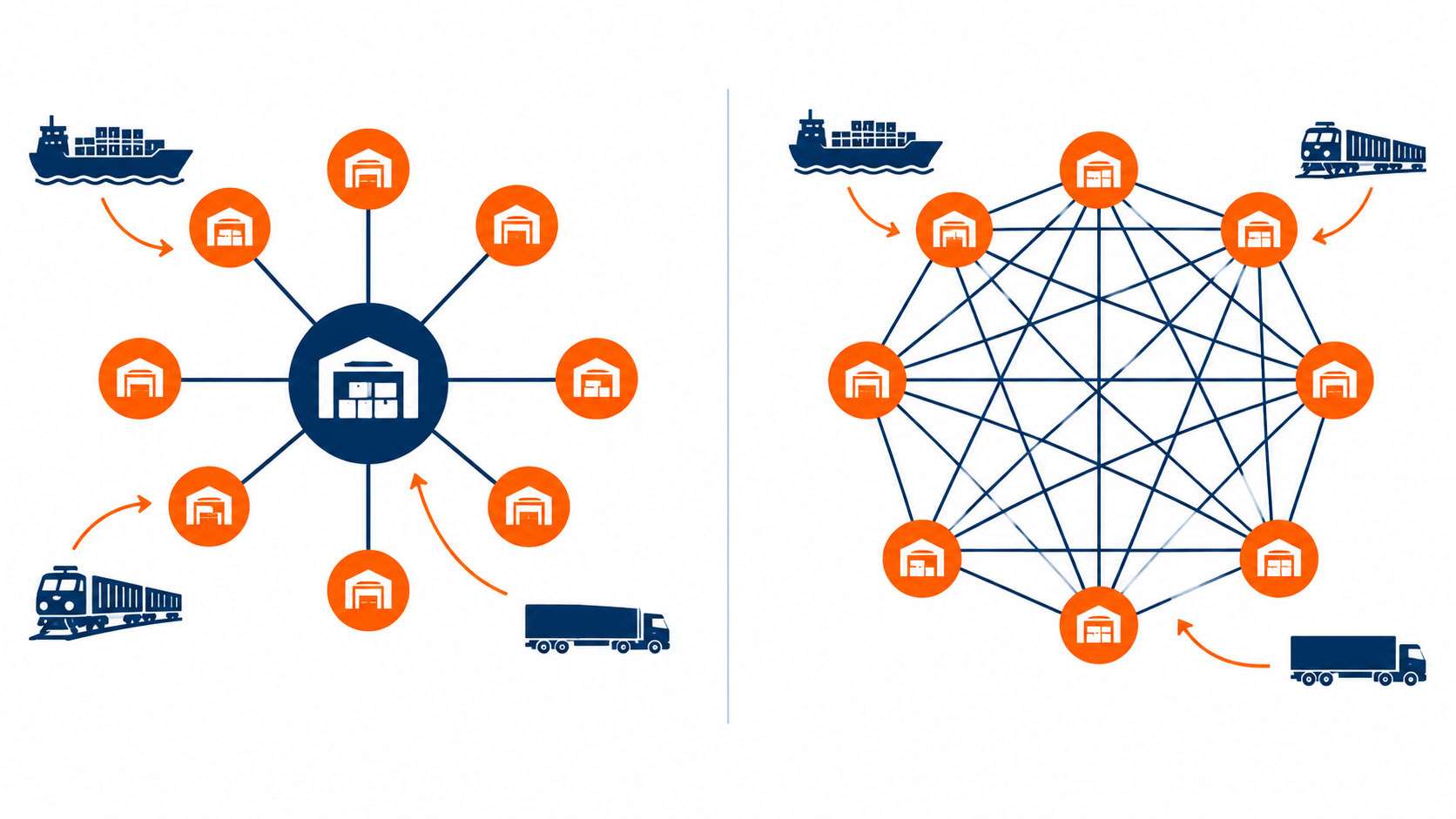
The word “hub” literally means the centre of a wheel, the part from which the spokes radiate. In logistics the meaning is the same. A hub is a central point where flows from different directions converge and from which they fan out again.
A simple analogy is a metro interchange station. A passenger does not need a direct line between every two stations in the city: they travel to an interchange, change trains and continue. Cargo works the same way. There is no need to run a separate service from every supplier to every consignee: it is enough to bring the cargo to a hub, combine it with other shipments and send it on as a larger consignment.
The Hub-and-Spoke Model and Direct Delivery
There are two basic ways to build routes in logistics.
- Hub-and-spoke. Cargo from all directions goes to a central node, where it is processed and distributed to final destinations. The trunk leg between hubs is densely loaded, so the cost of moving each unit of cargo is lower.
- Point-to-point (direct delivery). Cargo travels from shipper to consignee without intermediate handling. There are fewer transshipments and the route is shorter, but this only pays off with sufficient volume or urgency.
| Parameter | Via a hub (hub-and-spoke) | Direct delivery (point-to-point) |
|---|---|---|
| Cost for small consignments | Lower thanks to consolidation | Higher: transport may run partly empty |
| Transit time | Longer due to handling at the hub | Shorter if the route is direct |
| Number of transshipments | One or more | Minimal |
| Choice of destinations | Wide: the whole network is accessible from the hub | Limited to direct services |
| Best suited for | Groupage cargo, regular deliveries from many origins | Full containers and truckloads, urgent and sensitive cargo |
In practice, routes are often combined. For example, a full container travels by sea via a hub port with transshipment onto a feeder vessel, and after discharge goes straight to the consignee by truck.
What Functions Does a Hub Perform
A hub is not just a place where cargo changes transport. It is a set of operations that turns scattered shipments into a managed flow.
- Consolidation. Small consignments from different shippers are combined into one large one, for example several groupage shipments into a single container. This is cheaper than moving each consignment separately.
- Deconsolidation. The reverse operation: an arriving container or railcar is unloaded and the cargo is distributed to consignees.
- Sorting. Shipments are allocated by destination, urgency and type of onward transport.
- Transshipment. Cargo is transferred from one mode of transport to another: from ship to train, from train to truck, from aircraft to truck.
- Temporary storage. Cargo waits for the next sailing, for documents or for the consignee’s decision. Imported goods awaiting customs release are kept in a temporary storage warehouse (bonded warehouse).
- Customs clearance. International hubs usually have customs posts, so declaration, inspection and release of goods take place on site.
- Value-added services. Labelling, repacking, palletising, quantity and condition checks, insurance and document preparation.
WestComTrans operates its own temporary storage warehouses in Novorossiysk and in Turkey. In practice, this means cargo can be received, stored and prepared for clearance at a key point of the route without unnecessary intermediaries.
What a Transport Hub Consists Of
The set of components depends on the type and scale of the hub, but large nodes, especially seaports and multimodal hubs, share a common foundation.
- Terminals. Container, dry bulk, liquid bulk, ro-ro and air cargo terminals: areas where transport is loaded and unloaded.
- Warehouses and bonded storage. Indoor and open areas for storage, order picking and temporary storage of imported cargo pending release.
- Customs infrastructure. Customs posts, inspection zones and scanning facilities.
- Transport access. Rail tracks and stations, roads and truck parking; at ports, deep-water berths and approach channels.
- Information systems. Cargo tracking, terminal management and electronic document exchange with carriers and customs.
A hub’s strength is defined not by one component but by how they work together. A berth for large vessels is almost useless if the hinterland railway cannot clear containers fast enough. That is why, when choosing a route, you should look at the node as a whole.
Types of Transport Hubs
By Mode of Transport
- Sea hubs are major ports where containers are transshipped between ocean and feeder services, as well as onto rail and road.
- Air hubs are airports with well-developed cargo facilities for urgent, high-value and perishable goods.
- Rail hubs are major stations and terminals where container trains are formed and cargo is transferred at gauge changes.
- Road hubs are distribution terminals from which cargo is delivered across regions.
Multimodal Hubs and Dry Ports
A multimodal hub brings several modes of transport together in one place: for example, a seaport with a rail terminal and road access. It is the backbone of multimodal transport, where cargo travels by several modes under a single scheme.
A dry port is an inland terminal linked to a seaport by rail. Containers are moved there quickly from the port for storage, clearance and distribution. This relieves congestion at the port itself and brings cargo handling closer to the consignee.
By Scale
- Local hubs serve a city or metropolitan area.
- Regional hubs distribute flows across a large region or several countries.
- International (transshipment) hubs are nodes of global sea and air networks where cargo is transferred between services without entering the country of the hub.
| Hub type | Typical cargo | Strength | Limitation |
|---|---|---|---|
| Sea | Containers, dry and liquid bulk, machinery | Low cost for large volumes | Long transit times, dependence on carrier schedules |
| Air | Urgent, high-value, perishable cargo | Speed | High cost, size and weight restrictions |
| Rail | Containers, bulk cargo | Balance of price and speed on overland routes | Dependence on network capacity and border crossings |
| Road | Groupage and general cargo | Flexibility, door-to-door delivery | Inefficient over long distances for large volumes |
| Multimodal | Any, depending on the route | Change of transport in one place without losing time | Requires close coordination of all parties |
Hub, Logistics Centre, Terminal: What Is the Difference
These terms are often confused, although the facilities serve different purposes. A terminal is an element of infrastructure. A logistics centre is a complex for storing and handling goods. A hub is a network node through which flows are redistributed. The same port can be a hub, have several terminals and include a logistics centre at the same time.
| Criterion | Transport hub | Logistics centre | Terminal |
|---|---|---|---|
| Main purpose | Redistributing flows between destinations and modes of transport | Storage, order picking, distribution of goods | Loading, unloading and transshipment of a specific type of cargo |
| Dwell time of cargo | Usually short: cargo is in transit | From several days to long-term storage | Short, until pickup |
| Range of services | Wide: transshipment, consolidation, customs, storage | Warehousing and distribution, sometimes customs | Narrow, tied to the type of cargo |
| Scale | Node of a regional or international network | Facility of regional importance | Part of a port, station or airport |
| Users | Carriers, forwarders, importers and exporters | Distributors, retailers, manufacturers | Carriers and operators |
A separate note on the term “transport node”. It usually refers to an area where several transport routes and facilities converge, such as the Novorossiysk Transport Node. A hub is the functional role of such a node in the logistics network.

Why Hubs Matter for Foreign Trade
Hubs give importers and exporters several practical advantages.
- Savings on groupage cargo. If a consignment is smaller than a container, it is consolidated with other shipments and you pay only for the space used.
- Access to more destinations. A major hub has services to many ports, so cargo from a small port of loading can reach almost any destination.
- Predictability. Regular schedules of shipping lines and container trains via hubs help plan deliveries and inventory.
- One-stop clearance. Storage, documents and customs clearance happen in the same place where cargo changes transport.
- Flexibility when conditions change. If one direction is congested, it is easier to reroute cargo via a hub.
Risks and Limitations
The hub model also has a downside that should be taken into account when planning.
- Congestion. During peak periods, major ports and terminals operate at capacity: queues of vessels, railcars and trucks grow, and handling takes longer.
- Demurrage and detention. If a container stays at the port beyond the free period, a charge for extended use is applied (demurrage). If it is not returned on time after pickup, a charge for use outside the terminal applies (detention). Terms depend on the carrier and the port.
- Extra transshipments. Every transfer means extra time and a risk of damage. Fragile, oversized and temperature-sensitive cargo needs a route with minimal handling.
- Route restrictions. Some destinations, carriers and financial transactions are subject to sanctions and export controls of various countries. Before shipping, the route, carrier, ports of call, counterparties and goods must be checked for compliance with current requirements, in other words, pass a compliance check.
“A hub only saves money if the route is planned end to end: from the supplier’s warehouse to the consignee’s warehouse. We look in advance at where the cargo will be transshipped, where it will be stored and cleared, and we check the route and all parties to the deal for restrictions. That is cheaper than solving a problem when the container is already sitting at the port.”
Alexey Morozov, logistics specialist at WestComTrans
The World’s Largest Transport Hubs
Global trade relies on a few dozen major nodes. For Russian importers and exporters, the hubs that matter most are those on the routes where the main trade flows are now concentrated.
| Region | Key hubs | Role for cargo to and from Russia |
|---|---|---|
| China | Shanghai, Ningbo-Zhoushan, Shenzhen, Qingdao | Shanghai is the world’s largest container port (over 55 million TEU in 2025), Ningbo-Zhoushan ranks third. Cargo is shipped by sea to the Russian Far East and to the Black Sea |
| India | Nhava Sheva (Jawaharlal Nehru Port), Mundra | Container services operate from these ports to Novorossiysk; the International North–South Transport Corridor is also an option |
| UAE | Jebel Ali (Dubai), Khor Fakkan | A major transshipment and re-export hub of the Middle East. In 2026, due to the situation in the Strait of Hormuz, some cargo for Jebel Ali is routed via ports on the UAE’s east coast, primarily Khor Fakkan, and then overland |
| Turkey | Istanbul (Ambarli), Mersin, Kocaeli | Ambarli is Turkey’s largest container port, Mersin is second. The nearest major hubs to Novorossiysk, handling transshipment of cargo from Europe, Asia and the Middle East |
| Europe | Rotterdam, Antwerp-Bruges, Hamburg, Piraeus, Valencia | Consolidation of European cargo. Shipments to Russia are only possible for goods not subject to EU sanctions and export restrictions. Since 2022, the largest global carriers have not accepted most bookings to Russia, so cargo may be transshipped in third-country ports, such as in Turkey |
Singapore is the world’s second-largest container port and one of the biggest transshipment hubs: cargo between Asia, the Middle East and Europe passes through it, although for Russian routes it usually serves as an intermediate link rather than a final point.
Russia’s Transport Hubs and the Pivot to the East and South
The restructuring of Russia’s foreign trade has changed the role of its domestic hubs. The share of flows via Europe has declined, while the importance of Far Eastern, southern and overland routes has grown. According to the Association of Sea Commercial Ports, total cargo turnover of Russian ports in 2025 was 884.5 million tonnes (−0.4%). Only the Far Eastern basin showed growth (+6.6%, to 252.1 million tonnes), while the Baltic (271.3 million tonnes) and Azov-Black Sea (265.4 million tonnes) basins declined slightly.
North-West, Far East, Urals and Siberia
North-West: the ports of St Petersburg and Ust-Luga on the Baltic, historically focused on European services. Today they offer a growing number of services to ports in Asia and the Middle East.
Far East: Vladivostok, Vostochny and Nakhodka are the main sea gateways for cargo from China, Korea and the Asia-Pacific region. Their capacity largely depends on the throughput of the Trans-Siberian Railway and the Baikal-Amur Mainline.
Urals and Siberia: Yekaterinburg and Novosibirsk are major rail and distribution hubs through which cargo from Asia is distributed across Russia’s regions.
Novorossiysk: The Main Sea Hub of the South
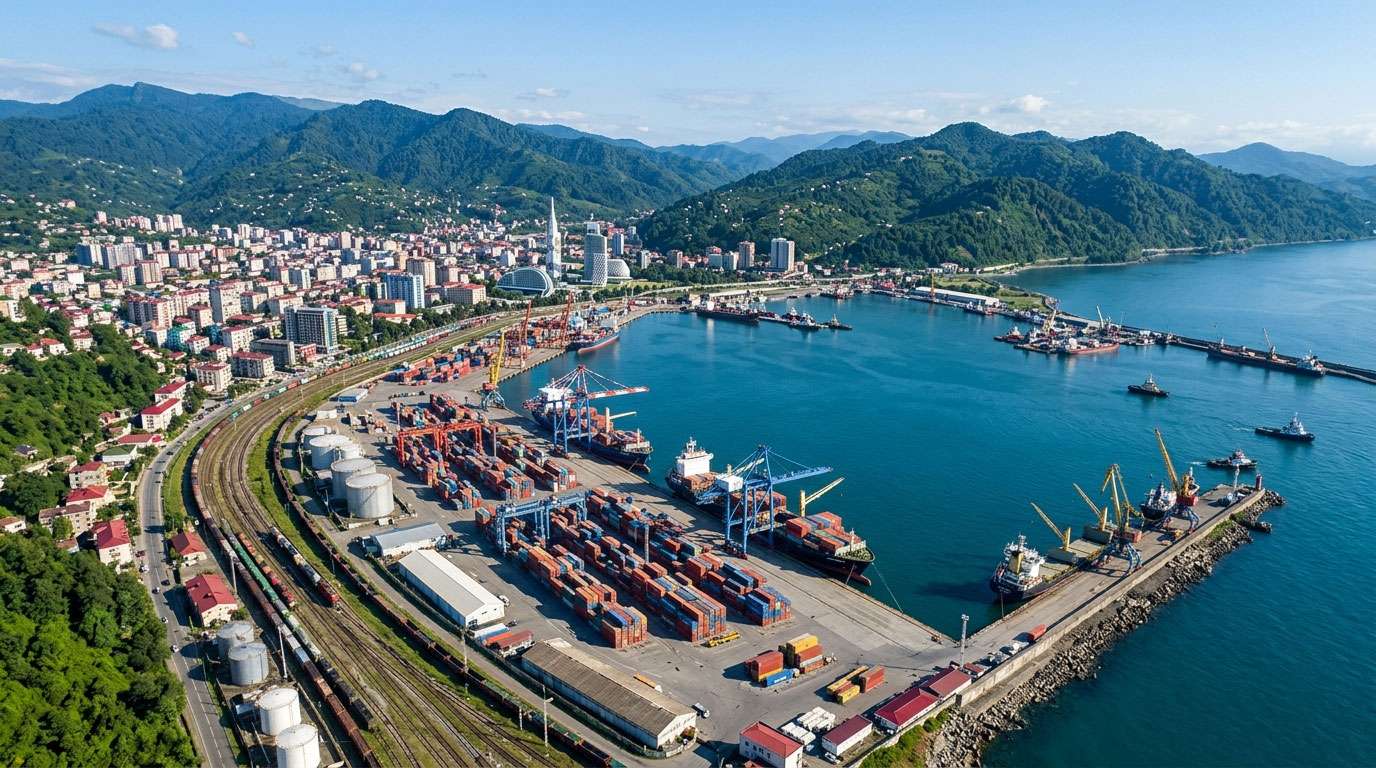
Novorossiysk is Russia’s largest port by cargo turnover and the main port of the Azov-Black Sea basin. In 2025 it handled 168 million tonnes of cargo, about 19% of the total for all Russian seaports. By container throughput the port ranked third in Russia (1.11 million TEU) after Vladivostok and St Petersburg. The Novorossiysk Transport Node combines sea terminals (container, grain, oil, general and bulk cargo), rail access and road links to federal highways.
Novorossiysk matters for foreign trade for several reasons.
- A deep-water, ice-free harbour allows large vessels to call all year round.
- Access to the Mediterranean via the Turkish Straits opens direct and feeder services to Turkey, Europe and the Middle East, and via the Suez Canal to India, the UAE and China. Due to the situation in the Red Sea, many carriers have sailed around Africa since 2024. In 2026 carriers are gradually returning to the Suez route, so the current routing should be checked for each shipment.
- Rail and road connections allow cargo to be moved quickly to central Russia, the Volga region and other regions.
- Well-developed customs and warehousing infrastructure with bonded warehouses and customs posts close to the terminals.
The node continues to expand. According to Russian Railways (May 2026), after modernisation the rail capacity of the Novorossiysk Transport Node will increase from 25.7 to 43 million tonnes of cargo per year, with completion planned for 2030. In parallel, NCSP Group is building a new deep-water terminal at the port for handling metal products and iron ore.
WestComTrans is based in Novorossiysk, and the company’s own temporary storage warehouse is located here. Cargo arriving by sea can be placed in temporary storage, cleared and sent on across Russia without unnecessary handovers between contractors.
New Routes: the North–South Corridor, Turkey, the UAE and the Role of the Black Sea
Against the backdrop of the pivot to the East and South, several routes have gained importance.
- International North–South Transport Corridor. It connects Russia with Iran, India and the Persian Gulf countries. It operates along several routes: western (via Azerbaijan), trans-Caspian (via Caspian ports) and eastern (via Kazakhstan and Turkmenistan). The western route still lacks a direct rail section between Rasht and Astara in Iran (about 160 km): Russia and Iran agreed to build it jointly back in 2023, but the timeline has slipped. As of September 2026, Russia’s Ministry of Transport plans to sign the contract by the end of the year.
- Turkey has become one of the key transshipment hubs for cargo from Europe and Asia to Russia thanks to its proximity to the Black Sea and its extensive network of services. WestComTrans has its own temporary storage warehouse in Turkey, which makes it possible to consolidate and store cargo on the Turkish side of the route.
- The UAE is a re-export and transshipment centre from which cargo moves to Russia by sea via Suez and the Black Sea or by combined routes. In 2026 shipping through the Strait of Hormuz is severely restricted, so some flows have shifted to ports on the UAE’s east coast and road delivery.
- The Black Sea as a whole links the ports of the Mediterranean, the Middle East and southern Russia, and Novorossiysk is the main gateway on this route.
How to Choose a Route Through a Hub: A Checklist for Importers and Exporters
Before agreeing on a route, answer a few questions.
- Where is the consignee located? The closer the hub port is to the final destination, the shorter and cheaper the land leg.
- What type and volume of cargo? Full container load (FCL) or less than container load (LCL), and whether temperature control or special packaging is needed.
- How critical is transit time? This determines the choice between transshipment via a hub, a direct service or a combined scheme.
- Which customs procedure is required? Release for domestic consumption, transit, temporary admission or export.
- How frequent are the services? Regular services reduce the risk of long waits at the hub.
- What is the node’s hinterland infrastructure? Rail, road access, warehouses and bonded storage, terminal congestion.
- Have compliance checks been passed? The route, carrier, ports of call, counterparties and the goods themselves must not be subject to restrictions.
- Who is responsible for the cargo at each stage? The fewer handovers between contractors, the lower the risk of loss and delay.
WestComTrans helps you manage this process from start to finish: we select a route through a suitable hub in Turkey, the UAE, China, India or Europe, arrange sea and multimodal transport, storage in our own temporary storage warehouses in Novorossiysk and Turkey, and customs clearance. If you are planning a shipment and want to know which route suits your cargo, describe your task to our specialists and we will propose a scheme that takes into account timing, budget and product requirements.

If you have any questions about the process of organizing container cargo transportation or would like to receive a consultation, feel free to contact us. We are ready to assist you at every stage of your cargo delivery!
WestComTrans – International Logistics.
Ответы на частые вопросы
A transport node is an area where several transport routes and facilities converge. A hub is the function of such a node in the logistics network: a place where flows are gathered and redistributed. A large transport node usually acts as a hub, but not every node is one.
In everyday language the terms are used interchangeably. Strictly speaking, “transport hub” emphasises the change of transport modes, while “logistics hub” implies a broader range of services: storage, consolidation, clearance and distribution.
No. A hub pays off for groupage cargo and destinations without direct services. For a full container on a popular route, a direct service may be both faster and cheaper. This is decided by calculating the costs for each specific shipment.
Transshipment is the transfer of cargo from one vessel to another at an intermediate port without importing it into the country of that port. For example, a container is moved from an ocean vessel to a feeder vessel heading to the port of destination.
Yes, if the hub has a customs post and a temporary storage warehouse. In Russian seaports, including Novorossiysk, clearance usually takes place in the port area or at nearby bonded warehouses, after which the cargo is released and goes to the consignee.


